

Contextual Retrieval With Milvus


Contextual Retrieval with Milvus
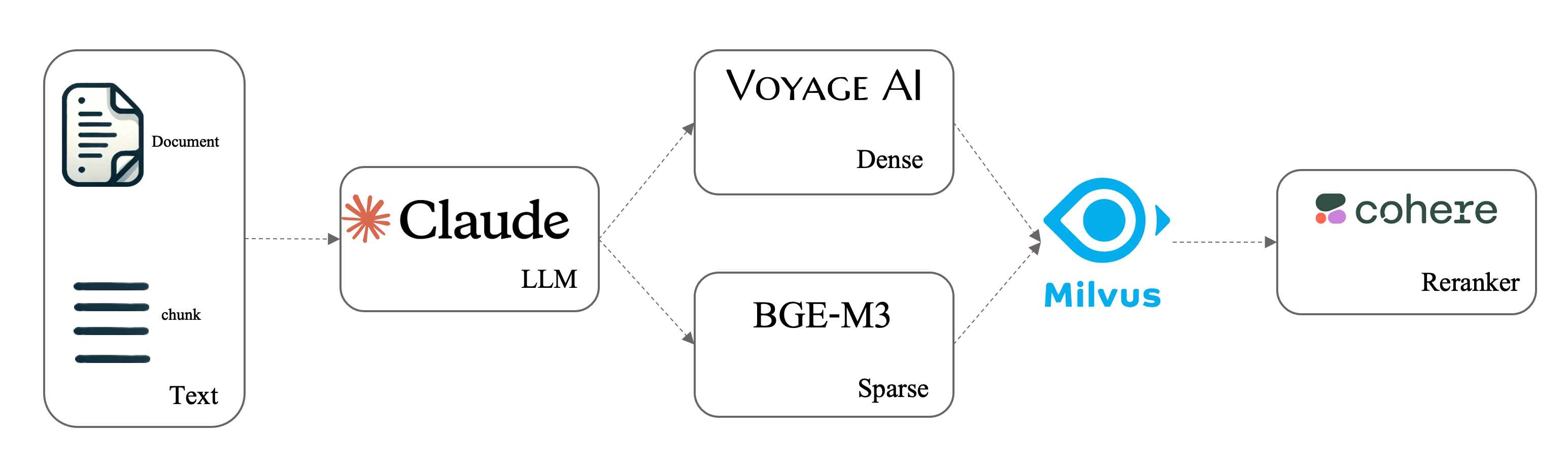 Contextual Retrieval is an advanced retrieval method proposed by Anthropic to address the issue of semantic isolation of chunks, which arises in current Retrieval-Augmented Generation (RAG) solutions. In the current practical RAG paradigm, documents are divided into several chunks, and a vector database is used to search for the query, retrieving the most relevant chunks. An LLM then responds to the query using these retrieved chunks. However, this chunking process can result in the loss of contextual information, making it difficult for the retriever to determine relevance.
Contextual Retrieval improves traditional retrieval systems by adding relevant context to each document chunk before embedding or indexing, boosting accuracy and reducing retrieval errors. Combined with techniques like hybrid retrieval and reranking, it enhances Retrieval-Augmented Generation (RAG) systems, especially for large knowledge bases. Additionally, it offers a cost-effective solution when paired with prompt caching, significantly reducing latency and operational costs, with contextualized chunks costing approximately $1.02 per million document tokens. This makes it a scalable and efficient approach for handling large knowledge bases. Anthropic’s solution shows two insightful aspects:
Document Enhancement: Query rewriting is a crucial technique in modern information retrieval, often using auxiliary information to make the query more informative. Similarly, to achieve better performance in RAG, preprocessing documents with an LLM (e.g., cleaning the data source, complementing lost information, summarizing, etc.) before indexing can significantly improve the chances of retrieving relevant documents. In other words, this preprocessing step helps bring the documents closer to the queries in terms of relevance.Low-Cost Processing by Caching Long Context: One common concern when using LLMs to process documents is the cost. The KVCache is a popular solution that allows reuse of intermediate results for the same preceding context. While most hosted LLM vendors make this feature transparent to user, Anthropic gives users control over the caching process. When a cache hit occurs, most computations can be saved (this is common when the long context remains the same, but the instruction for each query changes). For more details, click here.
In this notebook, we will demonstrate how to perform contextual retrieval using Milvus with an LLM, combining dense-sparse hybrid retrieval and a reranker to create a progressively more powerful retrieval system. The data and experimental setup are based on the contextual retrieval.
Preparation
Install Dependencies
If you are using Google Colab, to enable dependencies just installed, you may need to restart the runtime (click on the "Runtime" menu at the top of the screen, and select "Restart session" from the dropdown menu).
You will need API keys from Cohere, Voyage, and Anthropic to run the code.
Download Data
The following command will download the example data used in original Anthropic demo.
Define Retriever
This class is designed to be flexible, allowing you to choose between different retrieval modes based on your needs. By specifying options in the initialization method, you can determine whether to use contextual retrieval, hybrid search (combining dense and sparse retrieval methods), or a reranker for enhanced results.
Now you need to initialize these models for the following experiments. You can easily switch to other models using the PyMilvus model library.
Fetching 30 files: 0%| | 0/30 [00:00<?, ?it/s]
Experiment I: Standard Retrieval
Standard retrieval uses only dense embeddings to retrieve related documents. In this experiment, we will use Pass@5 to reproduce the results from the original repo.
Evaluating retrieval: 100%|██████████| 248/248 [01:29<00:00, 2.77it/s]
Pass@5: 80.92%
Total Score: 0.8091877880184332
Total queries: 248
Experiment II: Hybrid Retrieval
Now that we've obtained promising results with the Voyage embedding, we will move on to performing hybrid retrieval using the BGE-M3 model which generates powerful sparse embeddings. The results from dense retrieval and sparse retrieval will be combined using the Reciprocal Rank Fusion (RRF) method to produce a hybrid result.
Evaluating retrieval: 100%|██████████| 248/248 [02:09<00:00, 1.92it/s]
Pass@5: 84.69%
Total Score: 0.8469182027649771
Total queries: 248
Experiment III: Contextual Retrieval
Hybrid retrieval shows an improvement, but the results can be further enhanced by applying a contextual retrieval method. To achieve this, we will use Anthropic's language model to prepend the context from whole document for each chunk.
 Evaluating retrieval: 100%|██████████| 248/248 [01:55<00:00,  2.15it/s]
Pass@5: 87.14%
Total Score: 0.8713517665130568
Total queries: 248
Experiment IV: Contextual Retrieval with Reranker
The results can be further improved by adding a Cohere reranker. Without initializing a new retriever with reranker separately, we can simply configure the existing retriever to use the reranker for enhanced performance.
Evaluating retrieval: 100%|██████████| 248/248 [02:02<00:00,  2.00it/s]
Pass@5: 90.91%
Total Score: 0.9090821812596005
Total queries: 248
We have demonstrated several methods to improve retrieval performance. With more ad-hoc design tailored to the scenario, contextual retrieval shows significant potential to preprocess documents at a low cost, leading to a better RAG system.