

Qwen2 5 7B VL GRPO
To run this, press "Runtime" and press "Run all" on a free Tesla T4 Google Colab instance!


To install Unsloth on your local device, follow our guide. This notebook is licensed LGPL-3.0.
You will learn how to do data prep, how to train, how to run the model, & how to save it
News
Train MoEs - DeepSeek, GLM, Qwen and gpt-oss 12x faster with 35% less VRAM. Blog
You can now train embedding models 1.8-3.3x faster with 20% less VRAM. Blog
Ultra Long-Context Reinforcement Learning is here with 7x more context windows! Blog
3x faster LLM training with 30% less VRAM and 500K context. 3x faster • 500K Context
New in Reinforcement Learning: FP8 RL • Vision RL • Standby • gpt-oss RL
Visit our docs for all our model uploads and notebooks.
Installation
Unsloth
We're also introducing how you can do GSPO inside of Unsloth as well!
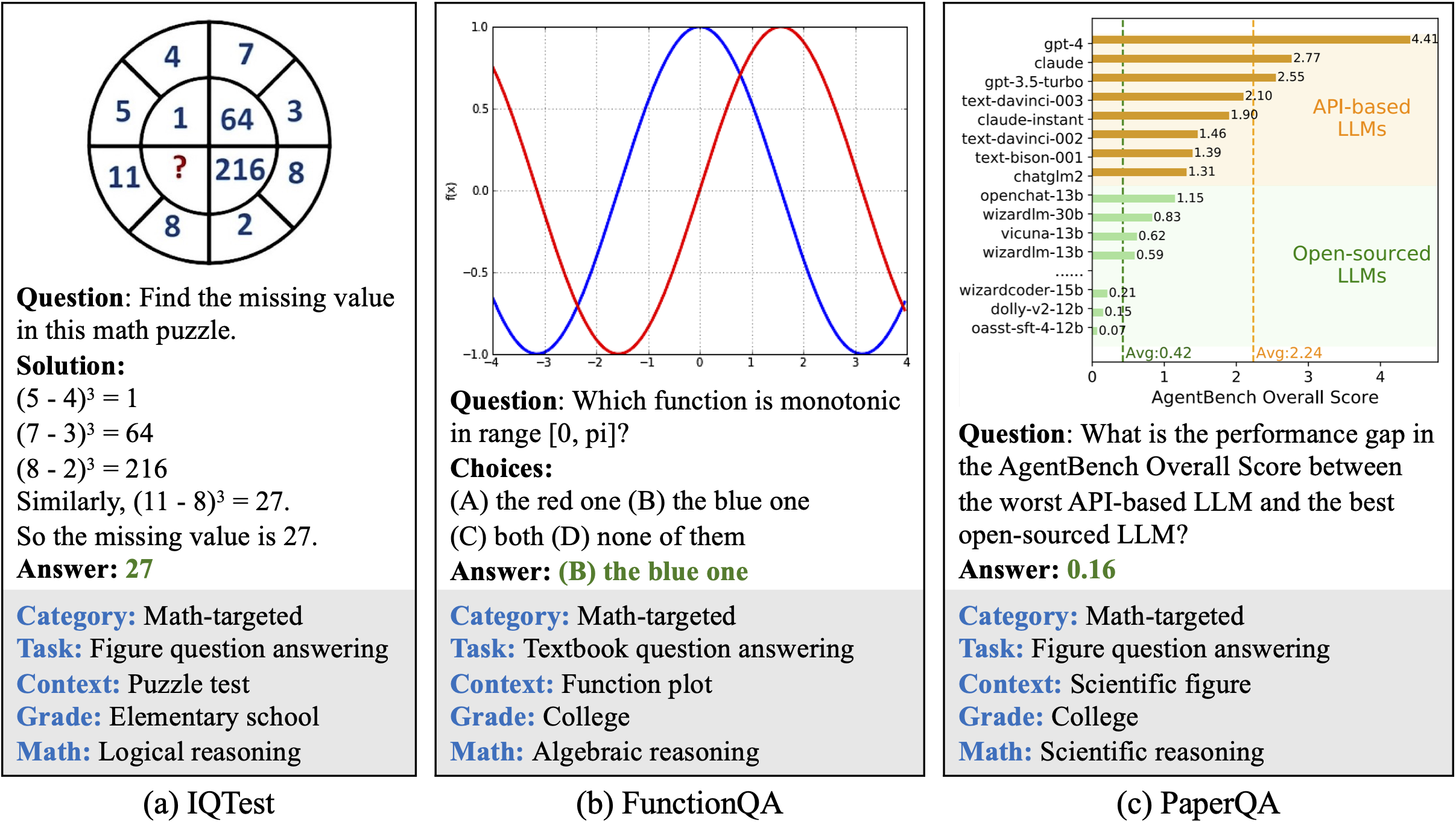
The goal of this notebook is to make a vision language model solve maths problems via reinforcement learning given an image input like below:
🦥 Unsloth: Will patch your computer to enable 2x faster free finetuning.
INFO 09-18 03:52:10 [__init__.py:244] Automatically detected platform cuda.
ERROR 09-18 03:52:12 [fa_utils.py:57] Cannot use FA version 2 is not supported due to FA2 is only supported on devices with compute capability >= 8
🦥 Unsloth Zoo will now patch everything to make training faster!
==((====))==  Unsloth 2025.9.6: Fast Qwen2_5_Vl patching. Transformers: 4.55.4. vLLM: 0.9.2.
   \\   /|    Tesla T4. Num GPUs = 1. Max memory: 14.741 GB. Platform: Linux.
O^O/ \_/ \    Torch: 2.7.0+cu126. CUDA: 7.5. CUDA Toolkit: 12.6. Triton: 3.2.0
\        /    Bfloat16 = FALSE. FA [Xformers = 0.0.30. FA2 = False]
 "-____-"     Free license: http://github.com/unslothai/unsloth
Unsloth: Fast downloading is enabled - ignore downloading bars which are red colored!
INFO 09-18 03:52:28 [vllm_utils.py:688] Unsloth: Patching vLLM v1 graph capture
INFO 09-18 03:52:28 [vllm_utils.py:716] Unsloth: Patching vLLM v0 graph capture
Unsloth: Vision model detected, setting approx_max_num_seqs to 1
Unsloth: vLLM loading unsloth/qwen2.5-vl-7b-instruct-unsloth-bnb-4bit with actual GPU utilization = 76.93%
Unsloth: Your GPU has CUDA compute capability 7.5 with VRAM = 14.74 GB.
Unsloth: Using conservativeness = 1.0. Chunked prefill tokens = 2048. Num Sequences = 1.
Unsloth: vLLM's KV Cache can use up to 5.21 GB. Also swap space = 0 GB.
preprocessor_config.json: 0%| | 0.00/791 [00:00<?, ?B/s]
INFO 09-18 03:52:46 [config.py:841] This model supports multiple tasks: {'reward', 'embed', 'generate', 'classify'}. Defaulting to 'generate'.
WARNING 09-18 03:52:46 [config.py:3371] Casting torch.bfloat16 to torch.float16.
INFO 09-18 03:52:46 [config.py:1472] Using max model len 16384
WARNING 09-18 03:52:46 [arg_utils.py:1735] Compute Capability < 8.0 is not supported by the V1 Engine. Falling back to V0.
WARNING 09-18 03:52:46 [arg_utils.py:1556] --enable-prefix-caching is not supported for multimodal models in V0 and has been disabled.
INFO 09-18 03:52:48 [config.py:2285] Chunked prefill is enabled with max_num_batched_tokens=16384.
Unsloth: vLLM Bitsandbytes config using kwargs = {'load_in_8bit': False, 'load_in_4bit': True, 'bnb_4bit_compute_dtype': 'float16', 'bnb_4bit_quant_storage': 'uint8', 'bnb_4bit_quant_type': 'nf4', 'bnb_4bit_use_double_quant': True, 'llm_int8_enable_fp32_cpu_offload': False, 'llm_int8_has_fp16_weight': False, 'llm_int8_skip_modules': ['embed_tokens', 'embedding', 'lm_head', 'multi_modal_projector', 'merger', 'modality_projection', 'router', 'visual', 'model.visual.blocks.31.mlp', 'model.visual.blocks.24.attn', 'model.visual.blocks.30.mlp', 'model.visual.blocks.30.attn', 'model.visual.blocks.25.attn', 'model.visual.blocks.29.attn', 'model.visual.blocks.26.attn', 'model.visual.blocks.28.attn', 'model.visual.blocks.19.attn', 'model.visual.blocks.29.mlp', 'model.visual.blocks.28.mlp', 'model.visual.blocks.31.attn', 'model.visual.blocks.25.mlp', 'model.visual.blocks.26.mlp', 'model.visual.blocks.20.attn', 'model.visual.blocks.27.mlp', 'model.visual.blocks.17.attn', 'model.visual.blocks.24.mlp', 'model.visual.blocks.18.attn', 'model.visual.blocks.16.attn', 'model.visual.blocks.11.attn', 'model.visual.blocks.21.mlp', 'model.visual.blocks.20.mlp', 'model.visual.blocks.23.mlp', 'model.visual.blocks.9.attn', 'model.visual.blocks.12.attn', 'model.visual.blocks.23.attn', 'model.visual.blocks.19.mlp', 'model.visual.blocks.22.mlp', 'model.visual.blocks.18.mlp', 'model.visual.blocks.13.attn', 'model.visual.blocks.8.attn', 'model.visual.blocks.11.mlp', 'model.visual.blocks.10.mlp', 'model.visual.blocks.6.attn', 'model.visual.blocks.15.mlp', 'model.visual.blocks.8.mlp', 'model.visual.blocks.9.mlp', 'model.visual.blocks.14.attn', 'model.visual.blocks.5.mlp', 'model.visual.blocks.14.mlp', 'model.visual.blocks.10.attn', 'model.visual.blocks.6.mlp', 'model.visual.blocks.7.mlp', 'model.visual.blocks.5.attn', 'model.visual.blocks.4.mlp', 'model.visual.blocks.16.mlp', 'model.visual.blocks.12.mlp', 'model.visual.blocks.13.mlp', 'model.visual.blocks.2.mlp', 'model.visual.blocks.3.mlp', 'model.visual.blocks.1.attn', 'model.visual.blocks.0.attn', 'model.visual.blocks.4.attn', 'model.visual.blocks.2.attn', 'model.visual.blocks.15.attn', 'model.visual.blocks.3.attn', 'model.visual.blocks.1.mlp', 'model.visual.blocks.17.mlp', 'model.visual.blocks.0.mlp', 'model.visual.blocks.7.attn', 'model.visual.blocks.31.mlp.down_proj'], 'llm_int8_threshold': 6.0}
INFO 09-18 03:52:48 [llm_engine.py:230] Initializing a V0 LLM engine (v0.9.2) with config: model='unsloth/qwen2.5-vl-7b-instruct-unsloth-bnb-4bit', speculative_config=None, tokenizer='unsloth/qwen2.5-vl-7b-instruct-unsloth-bnb-4bit', skip_tokenizer_init=False, tokenizer_mode=auto, revision=None, override_neuron_config={}, tokenizer_revision=None, trust_remote_code=False, dtype=torch.float16, max_seq_len=16384, download_dir=None, load_format=LoadFormat.BITSANDBYTES, tensor_parallel_size=1, pipeline_parallel_size=1, disable_custom_all_reduce=False, quantization=bitsandbytes, enforce_eager=False, kv_cache_dtype=auto,  device_config=cuda, decoding_config=DecodingConfig(backend='auto', disable_fallback=False, disable_any_whitespace=False, disable_additional_properties=False, reasoning_backend=''), observability_config=ObservabilityConfig(show_hidden_metrics_for_version=None, otlp_traces_endpoint=None, collect_detailed_traces=None), seed=0, served_model_name=unsloth/qwen2.5-vl-7b-instruct-unsloth-bnb-4bit, num_scheduler_steps=1, multi_step_stream_outputs=True, enable_prefix_caching=False, chunked_prefill_enabled=True, use_async_output_proc=True, pooler_config=None, compilation_config={"level":0,"debug_dump_path":"","cache_dir":"","backend":"inductor","custom_ops":[],"splitting_ops":[],"use_inductor":true,"compile_sizes":[],"inductor_compile_config":{"epilogue_fusion":true,"max_autotune":false,"shape_padding":true,"trace.enabled":false,"triton.cudagraphs":true,"debug":false,"dce":true,"memory_planning":true,"coordinate_descent_tuning":false,"trace.graph_diagram":false,"compile_threads":4,"group_fusion":true,"disable_progress":false,"verbose_progress":true,"triton.multi_kernel":0,"triton.use_block_ptr":true,"triton.enable_persistent_tma_matmul":true,"triton.autotune_at_compile_time":false,"triton.cooperative_reductions":false,"cuda.compile_opt_level":"-O2","cuda.enable_cuda_lto":true,"combo_kernels":false,"benchmark_combo_kernel":true,"combo_kernel_foreach_dynamic_shapes":true,"enable_auto_functionalized_v2":false},"inductor_passes":{},"use_cudagraph":true,"cudagraph_num_of_warmups":1,"cudagraph_capture_sizes":[1],"cudagraph_copy_inputs":false,"full_cuda_graph":true,"max_capture_size":1,"local_cache_dir":null}, use_cached_outputs=False,
tokenizer_config.json: 0.00B [00:00, ?B/s]
vocab.json: 0.00B [00:00, ?B/s]
merges.txt: 0.00B [00:00, ?B/s]
tokenizer.json: 0%| | 0.00/11.4M [00:00<?, ?B/s]
added_tokens.json: 0%| | 0.00/605 [00:00<?, ?B/s]
special_tokens_map.json: 0%| | 0.00/614 [00:00<?, ?B/s]
chat_template.jinja: 0.00B [00:00, ?B/s]
generation_config.json: 0%| | 0.00/237 [00:00<?, ?B/s]
INFO 09-18 03:52:55 [cuda.py:311] Cannot use FlashAttention-2 backend for Volta and Turing GPUs.
INFO 09-18 03:52:55 [cuda.py:360] Using XFormers backend.
INFO 09-18 03:52:55 [parallel_state.py:1076] rank 0 in world size 1 is assigned as DP rank 0, PP rank 0, TP rank 0, EP rank 0
INFO 09-18 03:52:55 [model_runner.py:1171] Starting to load model unsloth/qwen2.5-vl-7b-instruct-unsloth-bnb-4bit...
INFO 09-18 03:52:56 [bitsandbytes_loader.py:499] Loading weights with BitsAndBytes quantization. May take a while ...
INFO 09-18 03:52:58 [weight_utils.py:292] Using model weights format ['*.safetensors']
model.safetensors: 0%| | 0.00/6.90G [00:00<?, ?B/s]
INFO 09-18 03:54:06 [weight_utils.py:308] Time spent downloading weights for unsloth/qwen2.5-vl-7b-instruct-unsloth-bnb-4bit: 67.871041 seconds
INFO 09-18 03:54:06 [weight_utils.py:345] No model.safetensors.index.json found in remote.
Loading safetensors checkpoint shards: 0% Completed | 0/1 [00:00<?, ?it/s]
Loading safetensors checkpoint shards: 0% Completed | 0/1 [00:00<?, ?it/s]
INFO 09-18 03:54:33 [punica_selector.py:19] Using PunicaWrapperGPU.
INFO 09-18 03:54:35 [model_runner.py:1203] Model loading took 6.7940 GiB and 97.410629 seconds
video_preprocessor_config.json: 0%| | 0.00/935 [00:00<?, ?B/s]
chat_template.json: 0.00B [00:00, ?B/s]
INFO 09-18 03:55:37 [worker.py:294] Memory profiling takes 61.71 seconds
INFO 09-18 03:55:37 [worker.py:294] the current vLLM instance can use total_gpu_memory (14.74GiB) x gpu_memory_utilization (0.77) = 11.34GiB
INFO 09-18 03:55:37 [worker.py:294] model weights take 6.79GiB; non_torch_memory takes 0.03GiB; PyTorch activation peak memory takes 2.71GiB; the rest of the memory reserved for KV Cache is 1.81GiB.
INFO 09-18 03:55:38 [executor_base.py:113] # cuda blocks: 2118, # CPU blocks: 0
INFO 09-18 03:55:38 [executor_base.py:118] Maximum concurrency for 16384 tokens per request: 2.07x
INFO 09-18 03:55:38 [vllm_utils.py:721] Unsloth: Running patched vLLM v0 `capture_model`.
INFO 09-18 03:55:38 [model_runner.py:1513] Capturing cudagraphs for decoding. This may lead to unexpected consequences if the model is not static. To run the model in eager mode, set 'enforce_eager=True' or use '--enforce-eager' in the CLI. If out-of-memory error occurs during cudagraph capture, consider decreasing `gpu_memory_utilization` or switching to eager mode. You can also reduce the `max_num_seqs` as needed to decrease memory usage.
Capturing CUDA graph shapes: 0%| | 0/1 [00:00<?, ?it/s]
INFO 09-18 03:55:44 [model_runner.py:1671] Graph capturing finished in 6 secs, took 0.04 GiB
INFO 09-18 03:55:44 [vllm_utils.py:728] Unsloth: Patched vLLM v0 graph capture finished in 6 secs.
INFO 09-18 03:55:45 [llm_engine.py:428] init engine (profile, create kv cache, warmup model) took 70.40 seconds
Unsloth: Just some info: will skip parsing ['layer_norm1', 'layer_norm2', 'post_attention_layernorm', 'pre_feedforward_layernorm', 'post_feedforward_layernorm', 'q_norm', 'k_norm', 'post_layernorm', 'input_layernorm', 'norm1', 'norm2']
Unsloth: Just some info: will skip parsing ['layer_norm1', 'layer_norm2', 'cross_attn_input_layernorm', 'post_attention_layernorm', 'pre_feedforward_layernorm', 'post_feedforward_layernorm', 'q_norm', 'k_norm', 'post_layernorm', 'input_layernorm', 'cross_attn_post_attention_layernorm']
In Unsloth, we share vLLM's weights directly, reducing VRAM usage by > 50%. vLLM also does not yet support LoRA on the vision layers, so we can only add them on the language layers. Vision GRPO still works though!
Unsloth: Making `model.base_model.model.model.language_model` require gradients
README.md: 0.00B [00:00, ?B/s]
data/testmini-00000-of-00001-725687bf7a1(…): 0%| | 0.00/142M [00:00<?, ?B/s]
data/test-00000-of-00002-6b81bd7f7e2065e(…): 0%| | 0.00/358M [00:00<?, ?B/s]
data/test-00001-of-00002-6a611c71596db30(…): 0%| | 0.00/386M [00:00<?, ?B/s]
Generating testmini split: 0%| | 0/1000 [00:00<?, ? examples/s]
Generating test split: 0%| | 0/5141 [00:00<?, ? examples/s]
We filter the dataset to keep only float or numeric answers:
Filter: 0%| | 0/1000 [00:00<?, ? examples/s]
We also resize the images to be 512 by 512 pixels to make the images manageable in context length. We also convert them to RGB so they are compatible for training!
Map: 0%| | 0/566 [00:00<?, ? examples/s]
Map: 0%| | 0/566 [00:00<?, ? examples/s]
We then create the conversational template that is needed to collate the dataset for RL:
Map: 0%| | 0/566 [00:00<?, ? examples/s]
Now let's apply the chat template across the entire dataset:
Map: 0%| | 0/566 [00:00<?, ? examples/s]
Reward functions
We now define some basic formatting rewards functions to see if reasoning starts and ends, and also another to see if the answers were written correctly.
We also try to fix the addCriterion issue as described in our blog post
Here is the first example prompt in the dataset
"<|im_start|>system\nYou are a helpful assistant.<|im_end|>\n<|im_start|>user\n<|vision_start|><|image_pad|><|vision_end|>When a spring does work on an object, we cannot find the work by simply multiplying the spring force by the object's displacement. The reason is that there is no one value for the force-it changes. However, we can split the displacement up into an infinite number of tiny parts and then approximate the force in each as being constant. Integration sums the work done in all those parts. Here we use the generic result of the integration.\r\n\r\nIn Figure, a cumin canister of mass $m=0.40 \\mathrm{~kg}$ slides across a horizontal frictionless counter with speed $v=0.50 \\mathrm{~m} / \\mathrm{s}$. It then runs into and compresses a spring of spring constant $k=750 \\mathrm{~N} / \\mathrm{m}$. When the canister is momentarily stopped by the spring, by what distance $d$ is the spring compressed?. Also first provide your reasoning or working out on how you would go about solving the question between <REASONING> and </REASONING> and then your final answer between <SOLUTION> and (put a single float here) </SOLUTION><|im_end|>\n<|im_start|>assistant\n" Adding requests: 0%| | 0/1 [00:00<?, ?it/s]
Processed prompts: 0%| | 0/1 [00:00<?, ?it/s, est. speed input: 0.00 toks/s, output: 0.00 toks/s]
<REASONING>
To measure the length of the nail, we need to align it with the ruler and observe where it ends relative to the markings on the ruler.

1. Place the nail on the ruler so that the tip of the nail is at the 0-inch mark.
2. Observe where the back end of the nail falls on the ruler.
3. The back end of the nail appears to be just past the 3-inch mark but not quite reaching the 4-inch mark.

Since the question asks for the length to the nearest inch, we need to determine if the nail is closer to 3 inches or 4 inches in length. In this case, the nail is closer to 3 inches than to 4 inches because the back end of the nail is closer to the 3-inch mark than the 4-inch mark.

Therefore, the nail is about 3 inches long.
</REASONING>

<SOLUTION>
3</SOLUTION>
Unsloth: We now expect `per_device_train_batch_size` to be a multiple of `num_generations`.
We will change the batch size of 1 to the `num_generations` of 4
And let's run the trainer! If you scroll up, you'll see a table of rewards. The goal is to see the reward column increase!
You might have to wait 150 to 200 steps for any action. You'll probably get 0 reward for the first 100 steps. Please be patient!
| Step | Training Loss | reward | reward_std | completion_length | kl |
|---|---|---|---|---|---|
| 1 | 0.000000 | 0.125000 | 0.000000 | 200.000000 | 0.000000 |
| 2 | 0.000000 | 0.072375 | 0.248112 | 200.000000 | 0.000000 |
| 3 | 0.000000 | -0.079000 | 0.163776 | 182.500000 | 0.000005 |
During inference, you might encounter addCriterion or some weird gibberish outputs. Please read our blog post on why this occurs. It seems to be an inherent thing inside of the model, and we can ignore this.
==((====))==  Unsloth - 2x faster free finetuning | Num GPUs used = 1
   \\   /|    Num examples = 566 | Num Epochs = 1 | Total steps = 142
O^O/ \_/ \    Batch size per device = 4 | Gradient accumulation steps = 2
\        /    Data Parallel GPUs = 1 | Total batch size (4 x 2 x 1) = 8
 "-____-"     Trainable parameters = 40,370,176 of 8,332,536,832 (0.48% trained)
-------------------- Question:
<|im_start|>system
You are a helpful assistant.<|im_end|>
<|im_start|>user
<|vision_start|><|image_pad|><|vision_end|>What is the highest value on the X axis?. Also first provide your reasoning or working out on how you would go about solving the question between <REASONING> and </REASONING> and then your final answer between <SOLUTION> and (put a single float here) </SOLUTION><|im_end|>
<|im_start|>assistant

Answer:
30
Response:<REASONING>
To determine the highest value on the X-axis, I need to look at the numerical markings on the horizontal axis, which represents the "MICROGRAMS/mL-E-DNP-LYSIME-HCL" on the figure.

The X-axis is labeled with numerical values from 0 to 30, with increments of 5. The highest value marked on the X-axis is 30.

</REASONING>

<SOLUTION>
30.0 </SOLUTION>
Unsloth: Will smartly offload gradients to save VRAM!
-------------------- Question:
<|im_start|>system
You are a helpful assistant.<|im_end|>
<|im_start|>user
<|vision_start|><|image_pad|><|vision_end|>如图,点A、B、C都在半径为2的⊙O上,∠C=30°,则弦AB长为(). Also first provide your reasoning or working out on how you would go about solving the question between <REASONING> and </REASONING> and then your final answer between <SOLUTION> and (put a single float here) </SOLUTION><|im_end|>
<|im_start|>assistant
Answer:
2
Response:<REASONING>
To find the length of弦AB, we can use properties of circles and the angles subtended by the chord.
1. **Identify the angle subtended by the chord at the center**: The angle \(\angle AOB\) at the center O corresponds to the angle \(\angle ACB\) at the circumference. This is given by the Inscribed Angle Theorem, which states that the central angle is twice the inscribed angle that subtends the same arc. Therefore, if \(\angle ACB = 30^\circ\), then \(\angle AOB = 2 \times 30^\circ = 60^\circ\).
2. **Determine the triangle formed by the center and the endpoints of the chord**: Triangle OAB is an isosceles triangle with \(OA = OB = 2\) (since O is the center of the circle and the radius is 2). Since \(\angle AOB = 60^\circ\), triangle OAB is actually an equilateral triangle.
3. **Calculate the length of the chord**: In an equilateral triangle with side length \(s\), the length of any side is the same as the radius multiplied by \(\sqrt{3}\). Here, the side length \(s\) (which is the chord AB) is equal to the radius of the circle multiplied by \(\sqrt{3}\).
\[
AB = OA \cdot \sqrt{3} = 2 \cdot \sqrt{3} = 2\sqrt{3}
\]
</REASONING>
The length of chord AB is \(2\sqrt{3}\).
<SOLUTION>
2.4494897427831785
</SOLUTION>
-------------------- Question:
<|im_start|>system
You are a helpful assistant.<|im_end|>
<|im_start|>user
<|vision_start|><|image_pad|><|vision_end|>如图,在Rt△ABC中,∠BAC=90°,以Rt△ABC的三边为边分别向外作等边三角形△A'BC,△AB'C,△ABC',若△A'BC,△AB'C的面积分别是10和4,则△ABC'的面积是(). Also first provide your reasoning or working out on how you would go about solving the question between <REASONING> and </REASONING> and then your final answer between <SOLUTION> and (put a single float here) </SOLUTION><|im_end|>
<|im_start|>assistant
Answer:
6
Response:<REASONING>
To solve this problem, we need to understand the relationship between the areas of the equilateral triangles constructed on the sides of a right triangle.
Given:
- \( \triangle A'B'C' \) is an equilateral triangle with area \( 4 \).
- \( \triangle AB'C \) is an equilateral triangle with area \( 10 \).
In a right triangle \( \triangle ABC \) with \( \angle BAC = 90^\circ \), the areas of the equilateral triangles constructed on the legs \( AB \) and \( BC \) are related to the area of the equilateral triangle constructed on the hypotenuse \( AC \).
The area of an equilateral triangle formed from a side \( s \) of a right triangle is given by:
\[ \text{Area} \triangle = \frac{\sqrt{3}}{4} s^2 \]
However, the relevant property here is that the area of the equilateral triangle constructed on the hypotenuse is the sum of the areas of the equilateral triangles constructed on the two legs.
Let's denote the areas as follows:
- \( \text{Area} \triangle AB'C = A_1 = 10 \)
- \( \text{Area} \triangle A'B'C = A_2 = 4 \)
- \( \text{Area} \triangle ABC' = A_3 \) which we need to find.
According to the geometric property:
\[ A_3 = A_1 + A_2 \]
Thus:
\[ A_3 = 10 + 4 = 14 \]
Therefore, the area of the equilateral triangle \( \triangle ABC' \) is \( 14 \).
(Solution)
The area of \( \triangle ABC' \) is \( \boxed{14} \)
-------------------- Question:
<|im_start|>system
You are a helpful assistant.<|im_end|>
<|im_start|>user
<|vision_start|><|image_pad|><|vision_end|>The degree measures of minor arc $\widehat{A C}$ and major arc $\widehat{A D C}$ are $x$ and $y$ respectively. If $m∠ABC = 70°$, find $x$.. Also first provide your reasoning or working out on how you would go about solving the question between <REASONING> and </REASONING> and then your final answer between <SOLUTION> and (put a single float here) </SOLUTION><|im_end|>
<|im_start|>assistant
Answer:
110
Response:<REASONING>
To find the measure of the minor arc \(\widehat{AC}\), we need to understand the relationship between the angle \(\angle ABC\) and the arcs it intercepts on the circle.
1. **Identify the given information:**
- \(\angle ABC = 70^\circ\).
- \(\widehat{AC}\) is the minor arc.
- \(\widehat{AD}\) is the major arc.
- The degree measures of the arcs are denoted as \(x\) for \(\widehat{AC}\) and \(y\) for \(\widehat{AD}\).
2. **Understand the arc-intercept theorem:**
- The measure of an inscribed angle is half the measure of the arc it intercepts.
- Therefore, the measure of \(\angle ABC\) is half the measure of the arc \(\widehat{AC}\).
3. **Calculate the measure of \(\widehat{AC}\):**
\[
\text{Measure of } \widehat{AC} = 2 \times \text{Measure of } \angle ABC
\]
\[
\text{Measure of } \widehat{AC} = 2 \times 70^\circ = 140^\circ
\]
Thus, the measure of the minor arc \(\widehat{AC}\) is:
</REASONING>
<SOLUTION>
140
</SOLUTION>
-------------------- Question:
<|im_start|>system
You are a helpful assistant.<|im_end|>
<|im_start|>user
<|vision_start|><|image_pad|><|vision_end|>On average, how many people can commute on this vehicle?. Also first provide your reasoning or working out on how you would go about solving the question between <REASONING> and </REASONING> and then your final answer between <SOLUTION> and (put a single float here) </SOLUTION><|im_end|>
<|im_start|>assistant
Answer:
50
Response:<REASONING>
To estimate the number of people that can commute on this bus, we need to consider the seating capacity and standing capacity.
1. **Seating Capacity**: Typically, a bus has a fixed number of seats arranged for passengers. We can estimate the number of seats by visually inspecting the image. However, without precise dimensions or a seating chart, we can't provide an exact number. For a rough estimate, we can assume a bus of this size usually has around 50-60 seats, but this is a assumption and could vary significantly.
2. **Standing Capacity**: Buses also have space for people to stand. This is often less than the seating capacity, but can still be significant. The standing capacity for this bus might be around 30-40 people.
Adding these together:
- Seating capacity (approximately 50-60 people)
- Standing capacity (approximately 30-40 people)
Thus, the total capacity could be around:
- 50 + 30 = 80 people (if low estimate)
- 60 + 40 = 100 people (if high estimate)
For a rough average:
- 70 + 50 = 120 people (approximately)
However, these are rough estimates and actual capacity might vary.
</REASONING>
<SOLUTION>
120
</SOLUTION>
-------------------- Question:
<|im_start|>system
You are a helpful assistant.<|im_end|>
<|im_start|>user
<|vision_start|><|image_pad|><|vision_end|>In which year the market share of KLA is highest?. Also first provide your reasoning or working out on how you would go about solving the question between <REASONING> and </REASONING> and then your final answer between <SOLUTION> and (put a single float here) </SOLUTION><|im_end|>
<|im_start|>assistant
Answer:
2019
Response:<REASONING>
To determine in which year the market share of KLA was the highest, we need to compare the market shares of KLA for each year:
- In 2018, KLA's market share is 6.2%.
- In 2019, KLA's market share is 6.3%.
- In 2020, KLA's market share is 6.2% again.
We can see that KLA's market share does not change significantly from year to year. However, if we consider the slight increase in 2019, we can say that the market share in 2019 is the highest among the three years shown.
Final answer:
</REASONING>
<SOLUTION>
6.3 (as a float)</SOLUTION>
-------------------- Question:
<|im_start|>system
You are a helpful assistant.<|im_end|>
<|im_start|>user
<|vision_start|><|image_pad|><|vision_end|>Some students compared how many blocks they live from school. What is the mean of the numbers?'. Also first provide your reasoning or working out on how you would go about solving the question between <REASONING> and </REASONING> and then your final answer between <SOLUTION> and (put a single float here) </SOLUTION><|im_end|>
<|im_start|>assistant
Answer:
11
Response:<REASONING>
To find the mean of the numbers, we need to follow these steps:
1. Add up all the numbers in the "Number of blocks" column.
2. Count how many numbers there are in the list.
3. Divide the total sum by the count of numbers.
Let's do this step by step:
1. Adding up all the numbers:
14 + 8 + 17 + 17 + 3 + 7 + 5 + 17 = 86
2. Counting the numbers:
There are 8 numbers in the list.
3. Dividing the total sum by the count of numbers:
86 / 8 = 10.75
So, the mean of the numbers is 10.75.
</REASONING>
<SOLUTION>
10.75
</SOLUTION>
-------------------- Question:
<|im_start|>system
You are a helpful assistant.<|im_end|>
<|im_start|>user
<|vision_start|><|image_pad|><|vision_end|>Express the ratio of $\tan M$ as a decimal to the nearest hundredth.. Also first provide your reasoning or working out on how you would go about solving the question between <REASONING> and </REASONING> and then your final answer between <SOLUTION> and (put a single float here) </SOLUTION><|im_end|>
<|im_start|>assistant
Answer:
0.42
Response:To find the ratio of $\tan M$ in the given triangle, we need to follow these steps:
1. **Identify the sides of the triangle relative to angle \(M\):**
- The side opposite to angle \(M\) is the vertical side \(PN\).
- The side adjacent to angle \(M\) is the horizontal side \(PM\).
2. **Determine the lengths of the sides:**
- \(PN = 15\)
- \(PM = 36\)
3. **Calculate the tangent of angle \(M\):**
- The tangent of an angle in a right triangle is defined as the ratio of the length of the opposite side to the length of the adjacent side.
- Therefore, \(\tan M = \frac{PN}{PM} = \frac{15}{36}\).
4. **Simplify the fraction:**
- Simplify the fraction \(\frac{15}{36}\):
\[
\frac{15}{36} = \frac{15 \div 3}{36 \div 3} = \frac{5}{12}
\]
5. **Convert the fraction to a decimal:**
- To convert \(\frac{5}{12}\) to a decimal, perform the division:
\[
\frac{5}{12} \approx 0.4167
\]
6. **Round the decimal to the nearest hundredth:**
- The decimal \(0.4167\) rounded to the nearest hundredth is \(0.42\).
Therefore, the ratio of \(\tan M\) as a decimal to the nearest hundredth is:
\[
\boxed{0.42}
\]
-------------------- Question:
<|im_start|>system
You are a helpful assistant.<|im_end|>
<|im_start|>user
<|vision_start|><|image_pad|><|vision_end|>What is the age gap between these two people in image?. Also first provide your reasoning or working out on how you would go about solving the question between <REASONING> and </REASONING> and then your final answer between <SOLUTION> and (put a single float here) </SOLUTION><|im_end|>
<|im_start|>assistant
Answer:
14
Response:<REASONING>
To estimate the age gap between two individuals in a photograph, we can consider the following steps:
1. **Visual Assessment**: Observe the facial features, hair color, and general appearance of the individuals. Older individuals often show signs of more wrinkles, gray or white hair, and a more rounded face shape.
2. **Contextual Clues**: Look for any contextual clues such as the event or setting, which might give a clue about the relative ages. For example, if they are participating in a formal meeting or a celebratory event, it might suggest that they are within a similar age range.
3. **Photographic Quality**: Note any differences in the photo quality or the individuals' attire, as these can provide hints about the period the photo was taken in.
Given the image, both individuals are dressed formally, and the backdrop suggests a diplomatic or political meeting. However, visual assessment alone is not precise enough to determine the exact age gap.
Since precise age determination requires more detailed information than what's available in the image, this estimation method is limited.
Final Answer:
The image alone does not provide sufficient detailed information to accurately determine the age gap between the two individuals.
</REASONING>
<SOLUTION>
1
</SOLUTION>
-------------------- Question:
<|im_start|>system
You are a helpful assistant.<|im_end|>
<|im_start|>user
<|vision_start|><|image_pad|><|vision_end|>What value you get , if you divide the largest bar value by 2 ?. Also first provide your reasoning or working out on how you would go about solving the question between <REASONING> and </REASONING> and then your final answer between <SOLUTION> and (put a single float here) </SOLUTION><|im_end|>
<|im_start|>assistant
Answer:
131253.5
Response:<REASONING>
To solve the problem, we need to identify the value of the largest bar in the chart, which corresponds to the brand "Moschino." The value for "Moschino" is 262,507 thousand euros.
Next, we need to divide this value by 2 to find the result.
\[
\text{Result} = \frac{262,507}{2}
\]
Performing the division:
\[
\frac{262,507}{2} = 131,253.5
\]
Therefore, the value obtained by dividing the largest bar value by 2 is 131,253.5 thousand euros.
</REASONING>
<SOLUTION>
131253.5
</SOLUTION>
-------------------- Question:
<|im_start|>system
You are a helpful assistant.<|im_end|>
<|im_start|>user
<|vision_start|><|image_pad|><|vision_end|>What is the age gap between these two people in image?. Also first provide your reasoning or working out on how you would go about solving the question between <REASONING> and </REASONING> and then your final answer between <SOLUTION> and (put a single float here) </SOLUTION><|im_end|>
<|im_start|>assistant
Answer:
4
Response:<REASONING>
The image is a stained glass window featuring two figures, presumably King Richard III and Anne Neville. However, stained glass images are often symbolic and not meant to depict exact ages or historical age differences due to the nature of the medium and the artistic style.
There is no definitive way to determine the age gap between these two figures using the image alone. The figures are likely depicted in a stylized form that reflects their roles and historical significance rather than their actual ages.
Given the lack of accurate age representation in such images and the fabricated nature of chronicled age differences in historical figures, we cannot determine a specific age gap.
</REASONING>
<solution>
(since age is not accurately represented in stained glass, we cannot determine a definitive age gap beyond estimation or artistic perception) </solution>
-------------------- Question:
<|im_start|>system
You are a helpful assistant.<|im_end|>
<|im_start|>user
<|vision_start|><|image_pad|><|vision_end|>What is the age gap between these two people in image?. Also first provide your reasoning or working out on how you would go about solving the question between <REASONING> and </REASONING> and then your final answer between <SOLUTION> and (put a single float here) </SOLUTION><|im_end|>
<|im_start|>assistant
Answer:
8
Response:<REASONING>
To determine the age gap between the two people in the image, we need to make some observations and assumptions:
1. **Appearance**: The individuals appear to be adults, but without knowing the exact age, it's challenging to determine the age gap precisely. However, we can infer some general attributes:
- The person on the left seems to have a youthful appearance, possibly in their 30s.
- The person on the right appears slightly older, possibly in their 40s or early 50s.
2. **Clothing and Accessories**: The style of clothing and the vintage look of the photo suggest it could be from the mid-20th century. These historical contexts can help us estimate the approximate age, but they are not precise.
3. **Assumptions**: We need to assume based on the visual cues. The person on the left might be around 30 and the person on the right might be around 38, or some other reasonable estimate based on the visual cues.
<REASONING>
Using these rough estimates, the age gap can be calculated as follows:
- Let the age of the person on the left be \( A \approx 30 \).
- Let the age of the person on the right be \( B \approx 38 \).
The age gap \( G \) can be calculated as:
\[ G = B - A \]
\[ G = 38 - 30 \]
\[ G = 8 \]
Therefore, the age gap between the two people in the image is approximately 8 years.
</REASONING>
<SOLUTION>
8.0
</SOLUTION>
-------------------- Question:
<|im_start|>system
You are a helpful assistant.<|im_end|>
<|im_start|>user
<|vision_start|><|image_pad|><|vision_end|>Subtract all big red rubber cylinders. Subtract all blue objects. How many objects are left?. Also first provide your reasoning or working out on how you would go about solving the question between <REASONING> and </REASONING> and then your final answer between <SOLUTION> and (put a single float here) </SOLUTION><|im_end|>
<|im_start|>assistant
Answer:
7
Response:<REASONING>
1. First, identify all objects in the image.
2. Identify the objects that are big red rubber cylinders. There are none in the image.
3. Identify the blue objects. There are two blue objects: a large blue sphere and a small blue cube.
4. Subtract the blue objects from the total count of objects.
5. Count the remaining objects.
There are 8 objects in total. After removing the 2 blue objects, 6 objects remain.
</REASONING>
<SOLUTION>
6.0
</SOLUTION>
-------------------- Question:
<|im_start|>system
You are a helpful assistant.<|im_end|>
<|im_start|>user
<|vision_start|><|image_pad|><|vision_end|>What is the perimeter of the rectangle?. Also first provide your reasoning or working out on how you would go about solving the question between <REASONING> and </REASONING> and then your final answer between <SOLUTION> and (put a single float here) </SOLUTION><|im_end|>
<|im_start|>assistant
Answer:
6
Response:<REASONING>
To find the perimeter of a rectangle, we use the formula:
\[ \text{Perimeter} = 2 \times (\text{length} + \text{width}) \]
From the image, we can see that the length of the rectangle is 1 yard and the width is 2 yards. Plugging these values into the formula, we get:
\[ \text{Perimeter} = 2 \times (1 \text{ yd} + 2 \text{ yd}) \]
\[ \text{Perimeter} = 2 \times 3 \text{ yd} \]
\[ \text{Perimeter} = 6 \text{ yd} \]
</REASONING>
<SOLUTION>
The perimeter of the rectangle is 6 yards.
</SOLUTION>
-------------------- Question:
<|im_start|>system
You are a helpful assistant.<|im_end|>
<|im_start|>user
<|vision_start|><|image_pad|><|vision_end|>Subtract all small cyan cubes. Subtract all large yellow rubber cubes. How many objects are left?. Also first provide your reasoning or working out on how you would go about solving the question between <REASONING> and </REASONING> and then your final answer between <SOLUTION> and (put a single float here) </SOLUTION><|im_end|>
<|im_start|>assistant
Answer:
8
Response:<REASONING>
1. First, identify all objects in the image.
2. Identify the small cyan cube. There is one small cyan cube in the image.
3. Subtract the small cyan cube.
4. Identify large yellow rubber cubes. There are no large yellow rubber cubes in the image.
5. Subtract any large yellow rubber cubes (though there are none to subtract).
6. Count the remaining objects.
The image contains the following objects:
- 1 small cyan cube (subtracting this)
- 7 cylinders (1 gold, 1 red, 1 blue, 2 gray, 1 small gray, 1 red)
- 3 cubes (1 metallic red, 1 gray, 1 red)
After subtracting the small cyan cube, the remaining objects are 7 cylinders and 3 cubes, totaling 10 objects.
Final count: 10 objects left.
</REASONING>
<SOLUTION>
10.0
</SOLUTION>
-------------------- Question:
<|im_start|>system
You are a helpful assistant.<|im_end|>
<|im_start|>user
<|vision_start|><|image_pad|><|vision_end|>Subtract all blue balls. Subtract all big yellow rubber balls. How many objects are left?. Also first provide your reasoning or working out on how you would go about solving the question between <REASONING> and </REASONING> and then your final answer between <SOLUTION> and (put a single float here) </SOLUTION><|im_end|>
<|im_start|>assistant
Answer:
6
Response:<REASONING>
1. Identify all objects in the image.
2. Check for blue balls and big yellow rubber balls.
3. Subtract the blue ball from the count of objects.
4. Since there are no big yellow rubber balls, no additional subtraction is needed.
5. Count the remaining objects.
Step 1: Objects identified:
- A large blue cylinder
- A small red cylinder
- A small green cylinder
- A large red metallic sphere
- A small brown rectangular prism
- A small metallic sphere
- A small blue metallic ball
Step 2: Identifying blue balls and big yellow rubber balls:
- One blue metallic ball is present.
- No big yellow rubber balls are present.
Step 3: Subtract the blue ball:
- Remove the blue metallic ball from the count.
Step 4: No additional subtraction needed for big yellow rubber balls.
Step 5: Count the remaining objects:
- Large blue cylinder
- Small red cylinder
- Small green cylinder
- Large red metallic sphere
- Small brown rectangular prism
- Small metallic sphere
Total count of remaining objects: 6
</REASONING>
<SOLUTION>
6.0
</SOLUTION>
-------------------- Question:
<|im_start|>system
You are a helpful assistant.<|im_end|>
<|im_start|>user
<|vision_start|><|image_pad|><|vision_end|>What is the y-intercept of this function?. Also first provide your reasoning or working out on how you would go about solving the question between <REASONING> and </REASONING> and then your final answer between <SOLUTION> and (put a single float here) </SOLUTION><|im_end|>
<|im_start|>assistant
Answer:
1
Response:<REASONING>
To find the y-intercept of a function, you need to determine the value of y when x is equal to 0. This is because the y-intercept is the point where the graph of the function crosses the y-axis, and at that point, the x-coordinate is always 0.
Looking at the graph:
- The y-axis is the vertical line on the left side of the graph.
- The graph crosses the y-axis at the point where x = 0.
- At this point, the y-coordinate is the y-intercept.
By examining the graph, you can see that the graph crosses the y-axis at the point (0, 1).
Therefore, the y-intercept of the function is 1.
</REASONING>
<SOLUTION>
1.0
</SOLUTION>
-------------------- Question:
<|im_start|>system
You are a helpful assistant.<|im_end|>
<|im_start|>user
<|vision_start|><|image_pad|><|vision_end|>How many objects are preferred by more than 7 people in at least one category?. Also first provide your reasoning or working out on how you would go about solving the question between <REASONING> and </REASONING> and then your final answer between <SOLUTION> and (put a single float here) </SOLUTION><|im_end|>
<|im_start|>assistant
Answer:
3
Response:<REASONING>
To determine how many objects are preferred by more than 7 people in at least one category, we need to examine each bar in the chart and count the ones that exceed 7 in either the "satire" or "patch" category.
1. **Niece**:
- Satire: 7 people
- Patch: 9 people
- More than 7: Yes
2. **Racing**:
- Satire: 1 person
- Patch: 5 people
- More than 7: No
3. **Horn**:
- Satire: 8 people
- Patch: 9 people
- More than 7: Yes
4. **Saloon**:
- Satire: 7 people
- Patch: 8 people
- More than 7: Yes
5. **Dash**:
- Satire: 4 people
- Patch: 2 people
- More than 7: No
Count the objects that have more than 7 people in at least one category:
- Niece
- Horn
- Saloon
There are 3 objects that meet the criteria.
</REASONING>
<SOLUTION>
3.0 </SOLUTION>
-------------------- Question:
<|im_start|>system
You are a helpful assistant.<|im_end|>
<|im_start|>user
<|vision_start|><|image_pad|><|vision_end|>What is the sum of the accuracies of the algorithms squad and warm?. Also first provide your reasoning or working out on how you would go about solving the question between <REASONING> and </REASONING> and then your final answer between <SOLUTION> and (put a single float here) </SOLUTION><|im_end|>
<|im_start|>assistant
Answer:
7
Response:<REASONING>
To find the sum of the accuracies of the algorithms "squad" and "warm", we need to:
1. Identify the accuracy value for "squad".
2. Identify the accuracy value for "warm".
3. Add these two values together.
From the bar chart:
- The accuracy for "squad" is approximately 3.
- The accuracy for "warm" is approximately 4.
Adding these values:
3 + 4 = 7
</REASONING>
<SOLUTION>7.0</SOLUTION>
-------------------- Question:
<|im_start|>system
You are a helpful assistant.<|im_end|>
<|im_start|>user
<|vision_start|><|image_pad|><|vision_end|>Which number is missing?. Also first provide your reasoning or working out on how you would go about solving the question between <REASONING> and </REASONING> and then your final answer between <SOLUTION> and (put a single float here) </SOLUTION><|im_end|>
<|im_start|>assistant
Answer:
7
Response:To solve this problem, we need to identify the pattern or rule that governs the numbers in the given diagrams.
Let's analyze the first two diagrams to find the pattern:
1. In the first diagram:
- Top left number: 4
- Middle left number: 1
- Middle right number: 2
- Bottom right number: 5
- Bottom left number: 5
The sum of the numbers in the diagram is: 4 + 1 + 2 + 5 + 5 = 17
2. In the second diagram:
- Top left number: 6
- Middle left number: 3
- Middle right number: 3
- Bottom right number: 5
- Bottom left number: 5
The sum of the numbers in the diagram is: 6 + 3 + 3 + 5 + 5 = 20
From the first two diagrams, we can see that the sum of the numbers in each diagram is increasing by 3. So, the sum of the numbers in the first diagram is 17, and the sum of the numbers in the second diagram is 20.
To find the missing number in the third diagram, we need to find a number such that the sum of the numbers in the third diagram is one more than the sum of the numbers in the second diagram:
Sum of the numbers in the third diagram: 4 + 5 + ? + 7 = 16 + ?
We know the sum of the numbers in the second diagram is 20, so:
16 + ? = 23
? = 23 - 16
? = 7
Thus, the missing number is 7.
The final answer is 7.
-------------------- Question:
<|im_start|>system
You are a helpful assistant.<|im_end|>
<|im_start|>user
<|vision_start|><|image_pad|><|vision_end|>How many bars have values smaller than 0?. Also first provide your reasoning or working out on how you would go about solving the question between <REASONING> and </REASONING> and then your final answer between <SOLUTION> and (put a single float here) </SOLUTION><|im_end|>
<|im_start|>assistant
Answer:
0
Response:<REASONING>
To solve this question, we need to analyze the bar chart and determine the following:
1. Identify the number of bars that have values smaller than 0.
2. Check the values of the bars labeled "fusion," "lawn," and "afraid."
From the chart:
- The bar labeled "fusion" has a value of 0, which is not smaller than 0.
- The bar labeled "lawn" has a value of 0, which is not smaller than 0.
- The bar labeled "afraid" has a value of 2, which is not smaller than 0.
Since all the bars have values either equal to 0 or positive (2), none of them have values smaller than 0.
</REASONING>
<SOLUTION>
The number of bars with values smaller than 0 is 0.
</SOLUTION>
-------------------- Question:
<|im_start|>system
You are a helpful assistant.<|im_end|>
<|im_start|>user
<|vision_start|><|image_pad|><|vision_end|>The magnitude of the acceleration vector a is $10 \mathrm{~cm} / \mathrm{s}^2$. Use the figure to estimate the tangential components of $\mathbf{a}$.
. Also first provide your reasoning or working out on how you would go about solving the question between <REASONING> and </REASONING> and then your final answer between <SOLUTION> and (put a single float here) </SOLUTION><|im_end|>
<|im_start|>assistant
Answer:
4.5
Response:<REASONING>
To estimate the tangential components of the acceleration vector \(\mathbf{a}\), we need to understand the relationship between the total acceleration vector \(\mathbf{a}\), the tangential component \(\mathbf{a}_t\), and the normal component \(\mathbf{a}_n\). The total acceleration vector \(\mathbf{a}\) can be decomposed into these two components in a Curvilinear Motion context.
The tangential component of the acceleration \(\mathbf{a}_t\) represents the rate of change of the velocity's magnitude, which in this context is the magnitude of \(\mathbf{a}\) times the cosine of the angle \(\theta\) between \(\mathbf{a}\) and the velocity vector. The angle \(\theta\) is the angle between the acceleration vector and the tangent to the path of motion.
The normal component of the acceleration \(\mathbf{a}_n\) represents the acceleration due to the change in the direction of the velocity vector, which is the magnitude of \(\mathbf{a}\) times the sine of the angle \(\theta\).
Given that the magnitude of \(\mathbf{a}\) is \(10 \, \text{cm/s}^2\), and the velocity vector is tangent to the path of motion, the tangential component \(\mathbf{a}_t\) is simply the magnitude of \(\mathbf{a}\). This is because there is no change in the velocity's magnitude, only its direction.
So, we have:
\[
\mathbf{a}_t = 10 \, \text{cm/s}^2
\]
</REASONING>
<solution>
\(10.0\)
</solution>
-------------------- Question:
<|im_start|>system
You are a helpful assistant.<|im_end|>
<|im_start|>user
<|vision_start|><|image_pad|><|vision_end|>Move the ruler to measure the length of the slug to the nearest inch. The slug is about (_) inches long.. Also first provide your reasoning or working out on how you would go about solving the question between <REASONING> and </REASONING> and then your final answer between <SOLUTION> and (put a single float here) </SOLUTION><|im_end|>
<|im_start|>assistant
Answer:
3
Response:<REASONING>
To measure the length of the slug, we need to align the ruler with the slug's body and determine where it ends up in relation to the ruler's markings.
1. Place the ruler so that the zero mark of the ruler aligns with the starting point of the slug.
2. Observe where the end of the slug falls on the ruler.
3. Estimate the length based on the nearest inch markings.
From the image, the slug starts at the 0-inch mark and appears to end at the 3-inch mark. Since the end of the slug is closer to the 3-inch mark than the 4-inch mark, we can conclude that the slug is about 3 inches long.
</REASONING>
<SOLUTION>
3.0
</SOLUTION>
-------------------- Question:
<|im_start|>system
You are a helpful assistant.<|im_end|>
<|im_start|>user
<|vision_start|><|image_pad|><|vision_end|>What is the sum of the accuracies of the algorithms calf and ivory?. Also first provide your reasoning or working out on how you would go about solving the question between <REASONING> and </REASONING> and then your final answer between <SOLUTION> and (put a single float here) </SOLUTION><|im_end|>
<|im_start|>assistant
Answer:
13
Response:<REASONING>
To find the sum of the accuracies of the algorithms "ivory" and "calf," we need to:
1. Identify the accuracy value for the "ivory" algorithm.
2. Identify the accuracy value for the "calf" algorithm.
3. Add these two values together.
From the bar chart:
- The accuracy for the "ivory" algorithm is 9.
- The accuracy for the "calf" algorithm is 4.
Now, we add these values:
9 + 4 = 13
</REASONING>
<SOLUTION>
13.0
</SOLUTION>
-------------------- Question:
<|im_start|>system
You are a helpful assistant.<|im_end|>
<|im_start|>user
<|vision_start|><|image_pad|><|vision_end|>What is the age gap between these two people in image?. Also first provide your reasoning or working out on how you would go about solving the question between <REASONING> and </REASONING> and then your final answer between <SOLUTION> and (put a single float here) </SOLUTION><|im_end|>
<|im_start|>assistant
Answer:
13
Response:<REASONING>
To estimate the age gap between the two individuals in the image, we need to consider the following:
1. **Visual Aids**: The image is a black-and-white still from a movie, which does not provide direct information about their ages, but we can infer some details based on their appearance.
2. **Clothing and Appearance**: The older individual appears to be an older man with white hair and a calm demeanor, possibly indicating senior age. The younger individual appears to be a younger man, likely in his 30s or 40s based on his hairstyle and the serious, though not aggressive, expression.
3. **Contextual Clues**: The names "Spencer Tracy" appear on the right, identifying the individual on the right as a well-known actor who was known for roles where he portrayed older characters. Spencer Tracy was one of the most revered actors in Hollywood history and was known for his powerful performances across a wide range of ages.
Given these observations, the older individual seems to be in his 60s or 70s, while Spencer Tracy was born in 1900 and had a long careerspanishing into three different decades. Spencer Tracy, as a famous actor known for portraying older characters, would sometimes play youthful roles but typically was cast as a middle-aged or elderly character. The younger individual on the right would likely be in his 20s or 30s at the time.
Based on typical age ranges, the age gap would be substantial—perhaps around 30 to 40 years.
</REASONING>
<SOLUTION>
The age gap between the two individuals in the image is approximately **around 35 years**.
</SOLUTION>
-------------------- Question:
<|im_start|>system
You are a helpful assistant.<|im_end|>
<|im_start|>user
<|vision_start|><|image_pad|><|vision_end|>Find $m \angle 3$.. Also first provide your reasoning or working out on how you would go about solving the question between <REASONING> and </REASONING> and then your final answer between <SOLUTION> and (put a single float here) </SOLUTION><|im_end|>
<|im_start|>assistant
Answer:
38
Response:To find the measure of angle \(\angle 3\), we need to analyze the given information and the geometric properties of the square \(XYWT\) and the triangle \(TWZ\).
Here's the step-by-step reasoning:
1. **Identify the properties of the square:**
- \(XYWT\) is a square, so all its interior angles are \(90^\circ\) and all its sides are equal.
- The diagonal \(TW\) bisects the square into two right triangles \(WTX\) and \(WYX\).
2. **Determine the angles in the right triangles:**
- Since \(TW\) is a diagonal of the square, it forms right angles with the sides of the square at points \(W\) and \(X\).
- Therefore, \(\angle TWX = 90^\circ\) and \(\angle WTX = 90^\circ\).
3. **Identify the given angles:**
- The problem states that \(\angle 52^\circ\) is an angle within the square.
- This angle is part of the triangle \(TYX\), where \(\angle 52^\circ\) is one of the angles at vertex \(Y\).
4. **Find the remaining angle in \(\triangle TWZ\):**
- The sum of angles in a triangle is \(180^\circ\).
- We need to find \(\angle 3\), which is an angle in \(\triangle TWZ\).
5. **Analyze the triangle \(\triangle TWZ\):**
- Since \(TW\) is a diagonal of the square, it divides the square into two congruent right isosceles triangles.
- Therefore, \(\angle TWZ\) is part of the square's structure and must be considered in the context of the right isosceles triangle \(\triangle TWZ\).
6. **Calculate \(\angle 3\):**
- Given that the problem states \(\angle 3\) is part of the right isosceles triangle \(\triangle TWZ\), we need to calculate the remaining angles.
- The sum of angles in \(\triangle TWZ\) is \(180^\circ\).
- Since \(\triangle TWZ\) is a right triangle, one angle is \(90^\circ\).
From the given information and the properties of the square and triangles, we can conclude that \(\angle 3\) is part of the right isosceles triangle \(\triangle TWZ\) and can be calculated as follows:
\[
\angle 3 = 90^\circ - 52^\circ = 38^\circ
\]
Therefore, the measure of \(\angle 3\) is:
\[
\boxed{90^\circ - 52^\circ = 38^\circ}
\]
-------------------- Question:
<|im_start|>system
You are a helpful assistant.<|im_end|>
<|im_start|>user
<|vision_start|><|image_pad|><|vision_end|>When does the function start decreasing?. Also first provide your reasoning or working out on how you would go about solving the question between <REASONING> and </REASONING> and then your final answer between <SOLUTION> and (put a single float here) </SOLUTION><|im_end|>
<|im_start|>assistant
Answer:
5
Response:<REASONING>
To determine when the function starts decreasing, we need to look at the graph and identify the point where the function value changes from increasing to decreasing.
1. The function starts at a high value around 0.25.
2. It remains relatively constant around this value for the first few points.
3. Around the x-value of 5, the function begins to drop, indicating the start of the decreasing phase.
However, the function remains relatively flat at this high value for the first 3-4 points, so the actual decrease seems to begin around the x-value of 5.
</REASONING>
<SOLUTION>
The function starts decreasing around the x-value of 5.
</SOLUTION>
-------------------- Question:
<|im_start|>system
You are a helpful assistant.<|im_end|>
<|im_start|>user
<|vision_start|><|image_pad|><|vision_end|>Lily and her friends recorded their scores while playing a board game. Which score did the greatest number of people receive?'. Also first provide your reasoning or working out on how you would go about solving the question between <REASONING> and </REASONING> and then your final answer between <SOLUTION> and (put a single float here) </SOLUTION><|im_end|>
<|im_start|>assistant
Answer:
8
Response:<REASONING>
To determine which score received the greatest number of people, we need to look at the frequencies listed in the table provided.
Here is the frequency of each score:
- Score 6: 4 times
- Score 7: 10 times
- Score 8: 18 times
- Score 9: 6 times
- Score 10: 8 times
The score with the highest frequency is the one that the greatest number of people received.
Comparing the frequencies:
- 4 (for score 6)
- 10 (for score 7)
- 18 (for score 8)
- 6 (for score 9)
- 8 (for score 10)
The highest frequency is 18, which corresponds to the score of 8.
</REASONING>
<SOLUTION>
The score that the greatest number of people received is 8.
(8.0)</SOLUTION>
-------------------- Question:
<|im_start|>system
You are a helpful assistant.<|im_end|>
<|im_start|>user
<|vision_start|><|image_pad|><|vision_end|>Subtract all big red metallic spheres. Subtract all big brown matte things. How many objects are left?. Also first provide your reasoning or working out on how you would go about solving the question between <REASONING> and </REASONING> and then your final answer between <SOLUTION> and (put a single float here) </SOLUTION><|im_end|>
<|im_start|>assistant
Answer:
6
Response:<REASONING>
1. First, we need to identify all objects in the image.
2. There are 7 objects in total: 3 spheres and 4 cubes.
3. We need to subtract all big red metallic spheres. In the image, there are no red metallic spheres, so no objects are subtracted in this step.
4. Next, we need to subtract all big brown matte things. There is 1 big brown matte cube in the image.
5. Subtracting this big brown matte cube leaves us with 6 objects.
Final answer:
</REASONING>
<SOLUTION>6</SOLUTION>
-------------------- Question:
<|im_start|>system
You are a helpful assistant.<|im_end|>
<|im_start|>user
<|vision_start|><|image_pad|><|vision_end|>Several people compared how many Web pages they had visited. What is the mean of the numbers?'. Also first provide your reasoning or working out on how you would go about solving the question between <REASONING> and </REASONING> and then your final answer between <SOLUTION> and (put a single float here) </SOLUTION><|im_end|>
<|im_start|>assistant
Answer:
64
Response:<REASONING>
To find the mean of the numbers, we need to follow these steps:
1. Sum up all the numbers in the list.
2. Count how many numbers there are in the list.
3. Divide the sum by the count of numbers.
Let's start with step 1: Sum up all the numbers.
The numbers are: 84, 56, 70, 68, 60, 47, 75, 52.
Sum = 84 + 56 + 70 + 68 + 60 + 47 + 75 + 52
Let's add these step by step:
84 + 56 = 140
140 + 70 = 210
210 + 68 = 278
278 + 60 = 338
338 + 47 = 385
385 + 75 = 460
460 + 52 = 512
So, the sum of all the numbers is 512.
Next, step 2: Count how many numbers there are in the list.
There are 8 numbers in the list.
Finally, step 3: Divide the sum by the count of numbers.
Mean = Sum / Count
Mean = 512 / 8
Mean = 64
Therefore, the mean of the numbers is 64.
</REASONING>
<SOLUTION>
64.0
</SOLUTION>
-------------------- Question:
<|im_start|>system
You are a helpful assistant.<|im_end|>
<|im_start|>user
<|vision_start|><|image_pad|><|vision_end|>Find TX if $E X=24$ and $D E=7$. Also first provide your reasoning or working out on how you would go about solving the question between <REASONING> and </REASONING> and then your final answer between <SOLUTION> and (put a single float here) </SOLUTION><|im_end|>
<|im_start|>assistant
Answer:
32
Response:Certainly, let's solve the problem step-by-step.
First, let's analyze the given information and the geometric configuration:
- We have a circle with center \( D \).
- \( E \) and \( A \) are points on the circle.
- \( X \) is an external point.
- \( E X = 24 \).
- \( D E = 7 \).
- We need to find the length of \( T X \).
Since \( T \) is a point on the circle directly below \( D \) and since \( A \) is the point where the line through \( X \) intersects the circle again, \( A \) and \( T \) are symmetric points with respect to the center \( D \).
<REASONING>
1. Since \( D \) is the center of the circle, the line \( D E \) is a radius of the circle, so \( D E = 7 \).
2. The point \( T \) is directly below \( D \) on the diameter of the circle.
3. The line \( X E \) intersects the circle at points \( T \) and \( A \).
4. Given \( E X = 24 \), the segments \( X T \) and \( X A \) are equal in length because of the symmetry of the circle with respect to its center.
Since \( E X = 24 \) and the line extends symmetrically to \( T \) and \( T \) is directly below \( D \), the length \( X T \) is the same as \( E T = E X = 24 \).
Therefore, \( T X = E X = 24 \).
</REASONING>
The final answer is:
<SOLUTION>
24
</SOLUTION>
-------------------- Question:
<|im_start|>system
You are a helpful assistant.<|im_end|>
<|im_start|>user
<|vision_start|><|image_pad|><|vision_end|>Which year recorded the highest share of Urban secondary schools with access to electricity in India?. Also first provide your reasoning or working out on how you would go about solving the question between <REASONING> and </REASONING> and then your final answer between <SOLUTION> and (put a single float here) </SOLUTION><|im_end|>
<|im_start|>assistant
Answer:
2016
Response:<REASONING>
To determine the year with the highest share of upper secondary urban schools with access to electricity in India, we need to follow these steps:
1. Identify the trend for "Upper secondary" in the graph.
2. Compare the values for each year from 2012 to 2016.
3. Identify the year with the maximum value.
The graph shows a steady increase in the share of upper secondary schools with access to electricity from 2012 to 2016. The values appear to be roughly constant from 2012 to 2015, with a slight upward trend reaching its peak at the end of the period.
Since the graph is a line chart, the exact values are not provided, but we can infer that the highest point on the line for "Upper secondary" is at the end of the period in 2016.
</REASONING>
<SOLUTION>
2016
</SOLUTION>
-------------------- Question:
<|im_start|>system
You are a helpful assistant.<|im_end|>
<|im_start|>user
<|vision_start|><|image_pad|><|vision_end|>What is the average annual wage in Slovak Republic in the year 2019. Also first provide your reasoning or working out on how you would go about solving the question between <REASONING> and </REASONING> and then your final answer between <SOLUTION> and (put a single float here) </SOLUTION><|im_end|>
<|im_start|>assistant
Answer:
15017
Response:<REASONING>
The image is a line graph showing the average annual wage in the Slovak Republic from the year 2000 to 2019. To determine the average annual wage in the year 2019, we need to look at the data point corresponding to the latest year shown on the x-axis.
1. Identify the year on the x-axis: The year 2019 is the last point on the x-axis.
2. Identify the wage value for the year 2019: The data point for 2019 is at the value of 15,017 euros on the y-axis.
Therefore, the average annual wage in the Slovak Republic in the year 2019 is 15,017 euros.
</REASONING>
<SOLUTION>
15017.0
</SOLUTION>
-------------------- Question:
<|im_start|>system
You are a helpful assistant.<|im_end|>
<|im_start|>user
<|vision_start|><|image_pad|><|vision_end|>Subtract all big green cylinders. Subtract all rubber cylinders. How many objects are left?. Also first provide your reasoning or working out on how you would go about solving the question between <REASONING> and </REASONING> and then your final answer between <SOLUTION> and (put a single float here) </SOLUTION><|im_end|>
<|im_start|>assistant
Answer:
5
Response:<REASONING>
1. First, we need to identify all the objects in the image.
2. Then, we need to subtract all big green cylinders. There are no big green cylinders in the image, so this step does not remove any objects.
3. Next, we need to subtract all rubber cylinders. There are two rubber cylinders in the image: a purple cylinder and a gray cylinder. We will remove these two objects.
4. After removing the two rubber cylinders, we are left with the following objects:
- A blue reflective sphere
- A yellow reflective sphere
- A shiny blue cylinder
- A small green reflective sphere
- A yellow cube
5. Count the remaining objects: 5 objects.
</REASONING>
<SOLUTION>
5.0
</SOLUTION>
-------------------- Question:
<|im_start|>system
You are a helpful assistant.<|im_end|>
<|im_start|>user
<|vision_start|><|image_pad|><|vision_end|>How much more does a navy blue bath mat cost than a yellow bath towel? (Unit: $). Also first provide your reasoning or working out on how you would go about solving the question between <REASONING> and </REASONING> and then your final answer between <SOLUTION> and (put a single float here) </SOLUTION><|im_end|>
<|im_start|>assistant
Answer:
5
Response:<REASONING>
To find out how much more a navy blue bath mat costs than a yellow bath towel, we need to subtract the cost of the yellow bath towel from the cost of the navy blue bath mat.
Cost of navy blue bath mat = $17
Cost of yellow bath towel = $12
Difference in cost = Cost of navy blue bath mat - Cost of yellow bath towel
Difference in cost = $17 - $12
Difference in cost = $5
So, the navy blue bath mat costs $5 more than the yellow bath towel.
</REASONING>
<SOLUTION>
5.0 </SOLUTION>
-------------------- Question:
<|im_start|>system
You are a helpful assistant.<|im_end|>
<|im_start|>user
<|vision_start|><|image_pad|><|vision_end|>Find $RS$ if $\triangle QRS$ is an equilateral triangle.. Also first provide your reasoning or working out on how you would go about solving the question between <REASONING> and </REASONING> and then your final answer between <SOLUTION> and (put a single float here) </SOLUTION><|im_end|>
<|im_start|>assistant
Answer:
2
Response:<REASONING>
Since \(\triangle QRS\) is an equilateral triangle, all its sides must be equal in length. Therefore, we equate the given side lengths to find \(x\).
1. \(4x = 6x - 1\)
2. \(4x = 2x + 1\)
Solving these equations will give us the value of \(x\).
From the first equation:
\[4x = 6x - 1\]
\[4x - 6x = -1\]
\[-2x = -1\]
\[x = \frac{-1}{-2} = \frac{1}{2}\]
Substituting \(x = \frac{1}{2}\) into the second equation to verify:
\[4\left(\frac{1}{2}\right) = 2\left(\frac{1}{2}\right) + 1\]
\[2 = 1 + 1\]
\[2 = 2\]
The equation holds true, confirming \(x = \frac{1}{2}\).
Since all sides are equal in an equilateral triangle, we substitute \(x = \frac{1}{2}\) into one of the side expressions to find the length of \(RS\):
\[RS = 2x + 1 = 2\left(\frac{1}{2}\right) + 1 = 1 + 1 = 2\]
Thus, the length of \(RS\) is 2.
</REASONING>
<SOLUTION>
The length of \(RS\) is \(2\).
</SOLUTION>
-------------------- Question:
<|im_start|>system
You are a helpful assistant.<|im_end|>
<|im_start|>user
<|vision_start|><|image_pad|><|vision_end|>What is the age gap between the leftmost and the rigtmost person?. Also first provide your reasoning or working out on how you would go about solving the question between <REASONING> and </REASONING> and then your final answer between <SOLUTION> and (put a single float here) </SOLUTION><|im_end|>
<|im_start|>assistant
Answer:
5
Response:<REASONING>
To solve this question, we need to estimate the ages of the individuals in the image. Here's a step-by-step approach:
1. **Identify the individuals**: There are three people in the image. The leftmost person appears to be in her 60s, the middle person appears to be in her 40s, and the rightmost person appears to be in his 60s.
2. **Estimate age differences**:
- Between the leftmost person and the middle person: The leftmost person appears to be older than the middle person.
- Between the middle person and the rightmost person: The rightmost person appears to be older than the middle person, but possibly of the same age as the leftmost person, or perhaps slightly younger.
3. **Calculate age gap**:
- The age gap between the leftmost and the rightmost person is likely around the difference between being in her 60s and being in his 60s, which is approximately 10 years.
</REASONING>
<SOLUTION>
10.0
</SOLUTION>
-------------------- Question:
<|im_start|>system
You are a helpful assistant.<|im_end|>
<|im_start|>user
<|vision_start|><|image_pad|><|vision_end|>What is the value of the smallest individual bar in the whole chart?. Also first provide your reasoning or working out on how you would go about solving the question between <REASONING> and </REASONING> and then your final answer between <SOLUTION> and (put a single float here) </SOLUTION><|im_end|>
<|im_start|>assistant
Answer:
20
Response:<REASONING>
To determine the value of the smallest individual bar in the chart, we need to examine each bar and identify the one with the lowest value.
1. In the "locker" category, the blue bar (twist) has a value of 50.
2. In the "locker" category, the orange bar (cave) has a value of 30.
3. In the "tunnel" category, the blue bar (twist) has a value of 30.
4. In the "tunnel" category, the orange bar (cave) has a value of 20.
5. In the "niece" category, the blue bar (twist) has a value of 80.
6. In the "niece" category, the orange bar (cave) has a value of 60.
The smallest value among these is 20, which corresponds to the orange bar (cave) in the "tunnel" category.
</REASONING>
<SOLUTION>
20.0
</SOLUTION>
-------------------- Question:
<|im_start|>system
You are a helpful assistant.<|im_end|>
<|im_start|>user
<|vision_start|><|image_pad|><|vision_end|>Justine's P.E. class participated in a push-up competition, and Justine wrote down how many push-ups each person could do. How many people did at least 60 push-ups? (Unit: people). Also first provide your reasoning or working out on how you would go about solving the question between <REASONING> and </REASONING> and then your final answer between <SOLUTION> and (put a single float here) </SOLUTION><|im_end|>
<|im_start|>assistant
Answer:
11
Response:<REASONING>
To determine how many people did at least 60 push-ups, we need to look at the stem-and-leaf plot and count the number of entries that have a stem of 6 or greater, and all leaves associated with those stems.
- For the stem 6, the leaves are 3, 6, and 7. This means there are 3 people who did 63, 66, and 67 push-ups.
- For the stem 7, the leaves are 1, 3, 3, 5, 7, 7, and 8. This means there are 7 people who did 71, 73, 73, 75, 77, 77, and 78 push-ups.
Adding these together:
- From stem 6, there are 3 people.
- From stem 7, there are 7 people.
So, the total number of people who did at least 60 push-ups is 3 + 7 = 10.
</REASONING>
<SOLUTION>10</SOLUTION>
-------------------- Question:
<|im_start|>system
You are a helpful assistant.<|im_end|>
<|im_start|>user
<|vision_start|><|image_pad|><|vision_end|>What is the value of the largest bar?. Also first provide your reasoning or working out on how you would go about solving the question between <REASONING> and </REASONING> and then your final answer between <SOLUTION> and (put a single float here) </SOLUTION><|im_end|>
<|im_start|>assistant
Answer:
9
Response:<REASONING>
To determine the value of the largest bar in the bar chart, we need to:
1. Identify the height of each bar in the chart.
2. Compare the heights to find the tallest bar.
3. Read the value of the tallest bar from the y-axis.
The bar chart has six bars, each labeled with a word. The height of each bar corresponds to a value on the y-axis. By visually inspecting the chart, the bar labeled "nerve" is the tallest, and it reaches up to the value of 9 on the y-axis.
Therefore, the value of the largest bar is 9.
</REASONING>
<SOLUTION>
9.0
</SOLUTION>
-------------------- Question:
<|im_start|>system
You are a helpful assistant.<|im_end|>
<|im_start|>user
<|vision_start|><|image_pad|><|vision_end|>How many items sold less than 1 units in at least one store?. Also first provide your reasoning or working out on how you would go about solving the question between <REASONING> and </REASONING> and then your final answer between <SOLUTION> and (put a single float here) </SOLUTION><|im_end|>
<|im_start|>assistant
Answer:
0
Response:<REASONING>
To determine how many items sold less than 1 unit in at least one store, we need to examine the bars for each item and check if any of them fall below the 1 unit mark.
1. For the item "slip":
- The "logic" store has a value of 1.
- The "lung" store has a value of 3.
- The "twice" store has a value of 2.
- The "width" store has a value of 1.
None of the bars for "slip" fall below 1 unit.
2. For the item "peril":
- The "logic" store has a value of 4.
- The "lung" store has a value of 7.
- The "twice" store has a value of 8.
- The "width" store has a value of 7.
None of the bars for "peril" fall below 1 unit.
3. For the item "mate":
- The "logic" store has a value of 8.
- The "lung" store has a value of 2.
- The "twice" store has a value of 3.
- The "width" store has a value of 7.
The "lung" store for "mate" has a value of 2, which is exactly 1 unit and not less than 1 unit.
Since no bar falls below 1 unit for any of the items, the number of items sold less than 1 unit in at least one store is 0.
</REASONING>
<SOLUTION>
0.0
</SOLUTION>
-------------------- Question:
<|im_start|>system
You are a helpful assistant.<|im_end|>
<|im_start|>user
<|vision_start|><|image_pad|><|vision_end|>What is the value of r at theta=3*pi/2?. Also first provide your reasoning or working out on how you would go about solving the question between <REASONING> and </REASONING> and then your final answer between <SOLUTION> and (put a single float here) </SOLUTION><|im_end|>
<|im_start|>assistant
Answer:
-1
Response:<REASONING>
The image provided is a polar plot, which is typically used to represent a function of the form \( r(\theta) \). However, in this case, the plot appears to be a simple circular arc, which means the function \( r(\theta) \) is constant at all angles. The radius of the circle is approximately 0.6.
The angle \( \theta = 3\pi/2 \) radians is equivalent to 270 degrees. Since the function \( r(\theta) \) is constant, the value of \( r \) at any angle is the same as the radius of the circle, which is approximately 0.6.
Therefore, the value of \( r \) at \( \theta = 3\pi/2 \) is the same as the radius of the circle.
</REASONING>
<SOLUTION>
(0.6)
</SOLUTION>
-------------------- Question:
<|im_start|>system
You are a helpful assistant.<|im_end|>
<|im_start|>user
<|vision_start|><|image_pad|><|vision_end|>The shape is made of unit squares. What is the area of the shape?. Also first provide your reasoning or working out on how you would go about solving the question between <REASONING> and </REASONING> and then your final answer between <SOLUTION> and (put a single float here) </SOLUTION><|im_end|>
<|im_start|>assistant
Answer:
6
Response:<REASONING>
To find the area of the shape, we need to count the number of unit squares that make up the shape. The shape is a 2x2 grid, which means it is composed of 4 unit squares.
The area of a square is found by multiplying the length of one side by the length of another side. Since this is a 2x2 grid, the length of each side is 2 units.
Area = side × side
Area = 2 × 2
Area = 4 square units
Therefore, the area of the shape is 4 square units.
</REASONING>
<SOLUTION>
4.0
</SOLUTION>
-------------------- Question:
<|im_start|>system
You are a helpful assistant.<|im_end|>
<|im_start|>user
<|vision_start|><|image_pad|><|vision_end|>What is the sum of the two numbers visible in the picture?. Also first provide your reasoning or working out on how you would go about solving the question between <REASONING> and </REASONING> and then your final answer between <SOLUTION> and (put a single float here) </SOLUTION><|im_end|>
<|im_start|>assistant
Answer:
71
Response:<REASONING>
To solve this question, we need to identify the numbers visible in the image and then sum them up.
1. The number visible on the back of the bus is "1853".
2. There are no other numbers visible on the image that could be added to "1853".
Since there are no other numbers to add, the sum is simply the number "1853".
</REASONING>
<SOLUTION>
1853.0</SOLUTION>
-------------------- Question:
<|im_start|>system
You are a helpful assistant.<|im_end|>
<|im_start|>user
<|vision_start|><|image_pad|><|vision_end|>Subtract all blue metal things. Subtract all tiny objects. How many objects are left?. Also first provide your reasoning or working out on how you would go about solving the question between <REASONING> and </REASONING> and then your final answer between <SOLUTION> and (put a single float here) </SOLUTION><|im_end|>
<|im_start|>assistant
Answer:
4
Response:<REASONING>
1. Identify all blue metal objects: There is one blue metallic sphere.
2. Identify all tiny objects: There are two small red cylinders and a small blue cylinder.
3. Identify the remaining objects:
- The large red cylinder.
- The large purple cylinder.
- The large purple cube.
- The large red sphere.
4. Count the remaining objects: There are 4 objects left.
</REASONING>
<SOLUTION>
4.0
</SOLUTION>
-------------------- Question:
<|im_start|>system
You are a helpful assistant.<|im_end|>
<|im_start|>user
<|vision_start|><|image_pad|><|vision_end|>As shown in the figure, in the parallelogram ABCD, it is known that AB = 6.0, BC = 9.0, ∠B = 30.0, then the area of the parallelogram ABCD is (). Also first provide your reasoning or working out on how you would go about solving the question between <REASONING> and </REASONING> and then your final answer between <SOLUTION> and (put a single float here) </SOLUTION><|im_end|>
<|im_start|>assistant
Answer:
27
Response:<REASONING>
To find the area of parallelogram ABCD, we can use the formula for the area of a parallelogram, which is base times height. However, we need the height corresponding to the base AB.
Given:
- AB = 6.0
- BC = 9.0
- ∠B = 30.0 degrees
The height (h) can be found using trigonometry. Since ∠B is 30 degrees, we can consider triangle ABC as a 30-60-90 triangle. In a 30-60-90 triangle, the side opposite the 30-degree angle is half the length of the hypotenuse. Here, the hypotenuse is BC (9.0), so the height (which is the side opposite the 30-degree angle) is:
\[ h = \frac{9.0}{2} = 4.5 \]
Now, we can calculate the area of the parallelogram:
\[ \text{Area} = \text{base} \times \text{height} = 6.0 \times 4.5 = 27.0 \]
Therefore, the area of parallelogram ABCD is 27.0 square units.
</REASONING>
<SOLUTION>
27.0
</SOLUTION>
-------------------- Question:
<|im_start|>system
You are a helpful assistant.<|im_end|>
<|im_start|>user
<|vision_start|><|image_pad|><|vision_end|>What percent of people are wearing blue?. Also first provide your reasoning or working out on how you would go about solving the question between <REASONING> and </REASONING> and then your final answer between <SOLUTION> and (put a single float here) </SOLUTION><|im_end|>
<|im_start|>assistant
Answer:
0
Response:<REASONING>
To determine what percent of the people in the image are wearing blue, we need to follow these steps:
1. Identify the total number of people in the image.
2. Identify how many of these people are wearing blue.
3. Calculate the percentage of people wearing blue.
Step 1: There are 5 people in the image.
Step 2: The person on the right is wearing blue.
Step 3: Calculate the percentage of people wearing blue:
\[ \text{Percentage of people wearing blue} = \left( \frac{\text{Number of people wearing blue}}{\text{Total number of people}} \right) \times 100 \]
\[ \text{Percentage of people wearing blue} = \left( \frac{1}{5} \right) \times 100 = 20\% \]
</REASONING>
<SOLUTION>20.0</SOLUTION>
-------------------- Question:
<|im_start|>system
You are a helpful assistant.<|im_end|>
<|im_start|>user
<|vision_start|><|image_pad|><|vision_end|>What is the minimum value of this function?. Also first provide your reasoning or working out on how you would go about solving the question between <REASONING> and </REASONING> and then your final answer between <SOLUTION> and (put a single float here) </SOLUTION><|im_end|>
<|im_start|>assistant
Answer:
-1
Response:<REASONING>
To determine the minimum value of the function represented in the graph, we need to analyze the shape and behavior of the curve.
1. **Shape of the Curve**: The curve resembles a cosine function, which typically has a range from -1 to 1. The function oscillates between these two values, meaning the highest point is 1 and the lowest point is -1.
2. **Position of the Minimum**: The minimum value of a cosine function occurs when the function is at its lowest point, which is -1.
3. **Observing the Graph**: By looking at the graph, we can see that the lowest point on the curve aligns with the y-value of -1. This confirms that the minimum value of the function is -1.
</REASONING>
<SOLUTION>
-1.0
</SOLUTION>
-------------------- Question:
<|im_start|>system
You are a helpful assistant.<|im_end|>
<|im_start|>user
<|vision_start|><|image_pad|><|vision_end|>Some friends played a trivia game and recorded their scores. What is the mode of the numbers?'. Also first provide your reasoning or working out on how you would go about solving the question between <REASONING> and </REASONING> and then your final answer between <SOLUTION> and (put a single float here) </SOLUTION><|im_end|>
<|im_start|>assistant
Answer:
6
Response:<REASONING>
To find the mode of the scores, we need to identify the number that appears most frequently in the list of scores. Let's list the scores and count the frequency of each:
- Abigail: 6 (1 time)
- Bernie: 10 (1 time)
- Jada: 3 (1 time)
- Luke: 6 (1 time)
- Trent: 10 (1 time)
- Estelle: 6 (1 time)
- Garrett: 6 (1 time)
- Isabella: 3 (1 time)
From the list, we can see that the score 6 appears 4 times, which is more frequent than any other score. Therefore, the mode of the scores is 6.
</REASONING>
<SOLUTION>
The mode of the numbers is 6.0
</SOLUTION>
-------------------- Question:
<|im_start|>system
You are a helpful assistant.<|im_end|>
<|im_start|>user
<|vision_start|><|image_pad|><|vision_end|>What is the difference between the highest and the lowest dark blue bar?. Also first provide your reasoning or working out on how you would go about solving the question between <REASONING> and </REASONING> and then your final answer between <SOLUTION> and (put a single float here) </SOLUTION><|im_end|>
<|im_start|>assistant
Answer:
54
Response:<REASONING>
To find the difference between the highest and the lowest dark blue bar, we need to follow these steps:
1. Identify the value of the highest dark blue bar.
2. Identify the value of the lowest dark blue bar.
3. Subtract the value of the lowest dark blue bar from the value of the highest dark blue bar.
The dark blue bar, which represents the Asia Pacific region, shows values as follows:
- In 2013: 263
- In 2014: 288
- In 2015: 317
The highest value is 317 and the lowest value is 263.
Now, we subtract the lowest value from the highest value:
317 - 263 = 54
</REASONING>
<SOLUTION>
54.0
</SOLUTION>
-------------------- Question:
<|im_start|>system
You are a helpful assistant.<|im_end|>
<|im_start|>user
<|vision_start|><|image_pad|><|vision_end|>The Kingwood Ski Resort asked its guests how many times they went sledding last winter. How many guests went sledding more than 2 times?'. Also first provide your reasoning or working out on how you would go about solving the question between <REASONING> and </REASONING> and then your final answer between <SOLUTION> and (put a single float here) </SOLUTION><|im_end|>
<|im_start|>assistant
Answer:
0
Response:<REASONING>
To solve this question, we need to look at the frequency of sledding times greater than 2.
From the table:
- The number of guests who went sledding 0 times: 6
- The number of guests who went sledding 1 time: 4
- The number of guests who went sledding 2 times: 17
- The number of guests who went sledding 3 times: 0
Since there are no guests who went sledding more than 2 times (i.e., 3 times), the frequency for sledding more than 2 times is 0.
</REASONING>
<SOLUTION>
0.0
</SOLUTION>
-------------------- Question:
<|im_start|>system
You are a helpful assistant.<|im_end|>
<|im_start|>user
<|vision_start|><|image_pad|><|vision_end|>What is the overall ratio of male to female?. Also first provide your reasoning or working out on how you would go about solving the question between <REASONING> and </REASONING> and then your final answer between <SOLUTION> and (put a single float here) </SOLUTION><|im_end|>
<|im_start|>assistant
Answer:
1
Response:<REASONING>
To find the overall ratio of male to female, we need to follow these steps:
1. Identify the number of males and females in the year 2019.
2. Calculate the ratio of males to females.
3. Simplify the ratio if possible.
From the graph:
- In 2019, the number of males is approximately 21.43 million.
- In 2019, the number of females is approximately 21.48 million.
The ratio of males to females in 2019 is:
\[ \text{Ratio} = \frac{\text{Number of males}}{\text{Number of females}} = \frac{21.43}{21.48} \]
To simplify this ratio:
\[ \frac{21.43}{21.48} \approx \frac{21.43}{21.48} \approx 1 \]
This means that the ratio of males to females in 2019 is approximately 1:1.
</REASONING>
<SOLUTION>
The overall ratio of male to female is approximately 1.00.
</SOLUTION>
-------------------- Question:
<|im_start|>system
You are a helpful assistant.<|im_end|>
<|im_start|>user
<|vision_start|><|image_pad|><|vision_end|>For an assignment, Johnny looked at which countries got the most Nobel Prizes in various decades. In the 1990s, how many more Nobel Prize winners did Canada have than Italy? (Unit: Nobel Prize winners). Also first provide your reasoning or working out on how you would go about solving the question between <REASONING> and </REASONING> and then your final answer between <SOLUTION> and (put a single float here) </SOLUTION><|im_end|>
<|im_start|>assistant
Answer:
7
Response:<REASONING>
To determine how many more Nobel Prize winners Canada had than Italy in the 1990s, we need to look at the data provided in the table for Canada and Italy in the 1990s column.
- For Canada in the 1990s column, the number is 8.
- For Italy in the 1990s column, the number is 1.
Now, we subtract the number for Italy from the number for Canada:
8 (Canada) - 1 (Italy) = 7 Nobel Prize winners.
Therefore, Canada had 7 more Nobel Prize winners than Italy in the 1990s.
</REASONING>
<SOLUTION>
7.0
</SOLUTION>
-------------------- Question:
<|im_start|>system
You are a helpful assistant.<|im_end|>
<|im_start|>user
<|vision_start|><|image_pad|><|vision_end|>Find $x$ so that $a ∥ b$.. Also first provide your reasoning or working out on how you would go about solving the question between <REASONING> and </REASONING> and then your final answer between <SOLUTION> and (put a single float here) </SOLUTION><|im_end|>
<|im_start|>assistant
Answer:
14
Response:<REASONING>
To determine the value of \( x \) that makes lines \( a \) and \( b \) parallel, we need to use the property that corresponding angles formed by a transversal intersecting two parallel lines are equal. In the given diagram, the angles \((4x + 11)^\circ\) and \((8x + 1)^\circ\) are corresponding angles. Therefore, we can set up the following equation:
\[ 4x + 11 = 8x + 1 \]
Now, we solve this equation for \( x \):
1. Subtract \( 4x \) from both sides:
\[ 11 = 4x + 1 \]
2. Subtract 1 from both sides:
\[ 10 = 4x \]
3. Divide both sides by 4:
\[ x = \frac{10}{4} \]
\[ x = 2.5 \]
</REASONING>
<SOLUTION>
2.5
</SOLUTION>
-------------------- Question:
<|im_start|>system
You are a helpful assistant.<|im_end|>
<|im_start|>user
<|vision_start|><|image_pad|><|vision_end|>What is the maximum value of this function?. Also first provide your reasoning or working out on how you would go about solving the question between <REASONING> and </REASONING> and then your final answer between <SOLUTION> and (put a single float here) </SOLUTION><|im_end|>
<|im_start|>assistant
Answer:
1
Response:<REASONING>
To determine the maximum value of the function depicted in the graph, we need to observe the highest point the function reaches on the y-axis as the function moves along the x-axis.
1. **Identify the function type**: The graph resembles a sine wave, which is a periodic function that oscillates between positive and negative values.
2. **Determine the amplitude**: The amplitude of a sine wave is the maximum distance from the midline (which is the x-axis in this case) to the maximum or minimum point on the curve.
3. **Locate the peak**: The highest point on the curve, which is the maximum value of the function, is clearly visible as the y-coordinate at that point.
By visually inspecting the graph, the maximum value appears to be at approximately y = 1.0.
</REASONING>
<SOLUTION>
1.0
</SOLUTION>
-------------------- Question:
<|im_start|>system
You are a helpful assistant.<|im_end|>
<|im_start|>user
<|vision_start|><|image_pad|><|vision_end|>Subtract all big yellow metallic spheres. Subtract all tiny metal things. How many objects are left?. Also first provide your reasoning or working out on how you would go about solving the question between <REASONING> and </REASONING> and then your final answer between <SOLUTION> and (put a single float here) </SOLUTION><|im_end|>
<|im_start|>assistant
Answer:
7
Response:<REASONING>
1. First, identify all objects in the image.
2. Identify the "big yellow metallic spheres." There are no big yellow metallic spheres in the image, so this step does not remove any objects.
3. Identify the "tiny metal things." There are two tiny metal cylinders in the image, one gold and one red.
4. Subtract the two tiny metal cylinders from the total count of objects.
5. Count the remaining objects.
The total number of objects in the image is 8. Subtracting the 2 tiny metal cylinders leaves us with 6 objects.
Final answer: 6
</REASONING>
<SOLUTION>
6.0
</SOLUTION>
-------------------- Question:
<|im_start|>system
You are a helpful assistant.<|im_end|>
<|im_start|>user
<|vision_start|><|image_pad|><|vision_end|>A shipping company keeps track of the number of boxes in each shipment they send out. How many shipments had exactly 56 boxes? (Unit: shipments). Also first provide your reasoning or working out on how you would go about solving the question between <REASONING> and </REASONING> and then your final answer between <SOLUTION> and (put a single float here) </SOLUTION><|im_end|>
<|im_start|>assistant
Answer:
0
Response:<REASONING>
To solve this problem, we need to understand how to read the stem-and-leaf plot. The "stem" represents the tens digit, and the "leaf" represents the ones digit. For example, in the row with stem 5 and leaves 0, 3, and 9, the numbers represented are 50, 53, and 59 boxes.
We are asked to find how many shipments had exactly 56 boxes. Looking at the stem-and-leaf plot, we see:
- The stem 5 corresponds to the tens digit 5.
- The leaves for stem 5 are 0, 3, and 9.
Since 56 is represented as 0 and 6 in the stem-and-leaf plot, we can see that there is no 6 in the leaves for stem 5. Therefore, there are no shipments with exactly 56 boxes.
</REASONING>
<SOLUTION>
0.0
</SOLUTION>
-------------------- Question:
<|im_start|>system
You are a helpful assistant.<|im_end|>
<|im_start|>user
<|vision_start|><|image_pad|><|vision_end|>$\overline{WTY} \cong \overline{TWY}$. Find $x$.. Also first provide your reasoning or working out on how you would go about solving the question between <REASONING> and </REASONING> and then your final answer between <SOLUTION> and (put a single float here) </SOLUTION><|im_end|>
<|im_start|>assistant
Answer:
5
Response:<REASONING>
In the given diagram, we have a circle with a point \(X\) as the center. The lines \(WTY\) and \(TWY\) are given to be congruent, meaning \(WTY \cong TWY\).
When two chords in a circle are congruent, the arcs they intercept are also congruent, and the central angles opposite to these chords are equal. Therefore, the angles \(\angle WTY = \angle TWY\).
This implies that the lengths of the segments \(WT\) and \(TW\) are equal, which are represented as \(4x\) and \(2x + 10\) respectively.
Since \(WT = TW\), we can set up the following equation:
\[4x = 2x + 10\]
Subtract \(2x\) from both sides of the equation:
\[4x - 2x = 10\]
\[2x = 10\]
Divide both sides by 2:
\[x = 5\]
So, the value of \(x\) is \(5\).
</REASONING>
<SOLUTION>
\[
\boxed{5}
\]
-------------------- Question:
<|im_start|>system
You are a helpful assistant.<|im_end|>
<|im_start|>user
<|vision_start|><|image_pad|><|vision_end|>In which year there was lowest per capita real gross domestic product of ohio?. Also first provide your reasoning or working out on how you would go about solving the question between <REASONING> and </REASONING> and then your final answer between <SOLUTION> and (put a single float here) </SOLUTION><|im_end|>
<|im_start|>assistant
Answer:
2001
Response:<REASONING>
To determine the year with the lowest per capita real gross domestic product of Ohio, we need to examine the data points on the graph and identify the lowest value.
1. The graph shows the per capita real GDP for Ohio from 2000 to 2019.
2. We need to look at the y-axis values for each year.
3. The lowest value on the y-axis is the one we are interested in.
4. By visually inspecting the graph, we can see that the lowest value is at the point marked for the year 2009.
</REASONING>
<SOLUTION>
44169.5 </SOLUTION>
-------------------- Question:
<|im_start|>system
You are a helpful assistant.<|im_end|>
<|im_start|>user
<|vision_start|><|image_pad|><|vision_end|>In the figure, square $ABDC$ is inscribed in $\odot K$. Find the measure of a central angle.. Also first provide your reasoning or working out on how you would go about solving the question between <REASONING> and </REASONING> and then your final answer between <SOLUTION> and (put a single float here) </SOLUTION><|im_end|>
<|im_start|>assistant
Answer:
90
Response:<REASONING>
Given that square \(ABDC\) is inscribed in circle \(\odot K\), we need to find the measure of a central angle formed by any two adjacent vertices of the square and the center of the circle.
1. **Identify the properties of the square and the circle:**
- Since the square is inscribed in the circle, the diagonal of the square is the diameter of the circle.
- The center of the circle \(K\) is also the midpoint of the diagonal of the square.
- Therefore, the diagonal of the square is the diameter of the circle, which means the circle passes through all four vertices of the square.
2. **Understand the central angle:**
- A central angle is an angle subtended by an arc at the center of the circle.
- The vertices of the square divide the circle into four equal arcs.
3. **Calculate the angle subtended by one arc:**
- The total angle around the circle is \(360^\circ\).
- Since the square divides the circle into four equal arcs, the measure of each central angle is:
\[
\frac{360^\circ}{4} = 90^\circ
\]
Thus, the measure of the central angle subtended by any two adjacent vertices of the square and the center of the circle is \(90^\circ\).
</REASONING>
<SOLUTION>
The measure of a central angle is \(90^\circ\).
</SOLUTION>
-------------------- Question:
<|im_start|>system
You are a helpful assistant.<|im_end|>
<|im_start|>user
<|vision_start|><|image_pad|><|vision_end|>How many sequences have negative Influence Scores?. Also first provide your reasoning or working out on how you would go about solving the question between <REASONING> and </REASONING> and then your final answer between <SOLUTION> and (put a single float here) </SOLUTION><|im_end|>
<|im_start|>assistant
Answer:
2
Response:<REASONING>
To determine how many sequences have negative Influence Scores, we need to:
1. Identify the sequences that are displayed in the bar chart.
2. Check the orientation of the bars for each sequence. A bar that is below the x-axis indicates a negative Influence Score.
3. Count the number of sequences with bars below the x-axis.
Looking at the chart:
- The first sequence (blue bar) has a positive Influence Score.
- The second sequence (blue bar) has a positive Influence Score.
- The third sequence (blue bar) has a positive Influence Score.
- The fourth sequence (blue bar) has a positive Influence Score.
- The fifth sequence (blue bar) has a positive Influence Score.
- The sixth sequence (orange bar) has a positive Influence Score.
- The seventh sequence (blue bar) has a positive Influence Score.
- The eighth sequence (blue bar) has a positive Influence Score.
- The ninth sequence (blue bar) has a positive Influence Score.
- The tenth sequence (blue bar) has a positive Influence Score.
None of the sequences have bars below the x-axis, which means none of them have negative Influence Scores.
</REASONING>
<SOLUTION>
0.0
-------------------- Question:
<|im_start|>system
You are a helpful assistant.<|im_end|>
<|im_start|>user
<|vision_start|><|image_pad|><|vision_end|>What percentage of people prefer the least preferred object?. Also first provide your reasoning or working out on how you would go about solving the question between <REASONING> and </REASONING> and then your final answer between <SOLUTION> and (put a single float here) </SOLUTION><|im_end|>
<|im_start|>assistant
Answer:
10
Response:<REASONING>
To determine the percentage of people who prefer the least preferred object, we need to compare the height of the bars in the bar chart.
1. Identify the height of each bar:
- The bar for "liver" is approximately 30%.
- The bar for "warm" is approximately 10%.
- The bar for "shaft" is approximately 90%.
2. Compare the heights to find the smallest bar:
- The bar for "warm" is the smallest.
Therefore, the least preferred object is "warm," and the percentage of people who prefer this object is approximately 10%.
</REASONING>
<SOLUTION>10.0</SOLUTION>
-------------------- Question:
<|im_start|>system
You are a helpful assistant.<|im_end|>
<|im_start|>user
<|vision_start|><|image_pad|><|vision_end|>如图,在ABCD中,AB=5,AD=7,则ABCD的周长为(). Also first provide your reasoning or working out on how you would go about solving the question between <REASONING> and </REASONING> and then your final answer between <SOLUTION> and (put a single float here) </SOLUTION><|im_end|>
<|im_start|>assistant
Answer:
24
Response:<REASONING>
In the given parallelogram ABCD, the opposite sides are equal in length. Therefore, the length of side BC is also 5, and the length of side CD is also 7.
To find the perimeter of the parallelogram, we need to sum the lengths of all four sides:
- AB + BC + CD + DA
Given:
- AB = BC = 5
- CD = DA = 7
So, the perimeter \( P \) is:
\[ P = AB + BC + CD + DA = 5 + 5 + 7 + 7 = 24 \]
Therefore, the perimeter of parallelogram ABCD is 24.
</REASONING>
<SOLUTION>
24.0
</SOLUTION>
-------------------- Question:
<|im_start|>system
You are a helpful assistant.<|im_end|>
<|im_start|>user
<|vision_start|><|image_pad|><|vision_end|>In how many years, is the percentage of undernourished male children greater than 0.4 %?. Also first provide your reasoning or working out on how you would go about solving the question between <REASONING> and </REASONING> and then your final answer between <SOLUTION> and (put a single float here) </SOLUTION><|im_end|>
<|im_start|>assistant
Answer:
4
Response:<REASONING>
To solve this question, we need to analyze the data presented in the scatter plot. The plot shows the prevalence of severe wasting in two categories: female (red) and male (cyan) for children under 5 years old in Sudan over a few years.
Here are the steps to solve the question:
1. Identify the years shown on the x-axis.
2. For each year, determine if the corresponding average percentage for male children (cyan dots) is greater than 0.
Looking at the data:
- In 1993, the cyan dot for males is above 0.
- In 1995, the cyan dot for males is above 0.
- In 2000, the cyan dot for males is above 0.
- In 2006, the cyan dot for males is above 0.
Thus, the male percentage of undernourished children is greater than 0 in all four years.
</REASONING>
<SOLUTION>
4.0
</SOLUTION>
-------------------- Question:
<|im_start|>system
You are a helpful assistant.<|im_end|>
<|im_start|>user
<|vision_start|><|image_pad|><|vision_end|>What is the age gap between these two people in image?. Also first provide your reasoning or working out on how you would go about solving the question between <REASONING> and </REASONING> and then your final answer between <SOLUTION> and (put a single float here) </SOLUTION><|im_end|>
<|im_start|>assistant
Answer:
16
Response:<REASONING>
To determine the age gap between the two individuals in the image, we need to estimate their approximate ages based on their physical appearance, clothing, and the style of their uniforms. Here's a step-by-step approach:
1. **Estimate Age for Individual 1:**
- Individual 1 appears to be wearing a military uniform that resembles a World War II-era style, specifically resembling the attire of General Dwight D. Eisenhower.
- Based on the visible features, such as the style of the uniform and the military cap, this individual appears to be older, likely in his 60s or 70s.
2. **Estimate Age for Individual 2:**
- Individual 2 is wearing a military uniform with a different style, likely reminiscent of the French Foreign Legion's uniform, which is often associated with berets and simpler design.
- The individual appears younger compared to Individual 1, possibly in his 40s or 50s.
3. **Calculate the Age Gap:**
- If we estimate:
- Individual 1 to be around 70 years old.
- Individual 2 to be around 45 years old.
- The age gap between them would be approximately 25 years.
<ANCHOR>
</ANCHOR>
<SOLUTION>
The estimated age gap between the two individuals is approximately 25 years.
</SOLUTION>
(25)
-------------------- Question:
<|im_start|>system
You are a helpful assistant.<|im_end|>
<|im_start|>user
<|vision_start|><|image_pad|><|vision_end|>Fill in the blank to describe the model. The model has 9 dots divided into 3 equal groups. There are (_) dots in each group.. Also first provide your reasoning or working out on how you would go about solving the question between <REASONING> and </REASONING> and then your final answer between <SOLUTION> and (put a single float here) </SOLUTION><|im_end|>
<|im_start|>assistant
Answer:
3
Response:<REASONING>
To solve this problem, we need to determine how many dots are in each group when 9 dots are divided into 3 equal groups.
1. Start with the total number of dots: 9.
2. Divide the total number of dots by the number of groups: 9 ÷ 3 = 3.
3. The result of the division gives us the number of dots in each group.
</REASONING>
<SOLUTION>
3</SOLUTION>
-------------------- Question:
<|im_start|>system
You are a helpful assistant.<|im_end|>
<|im_start|>user
<|vision_start|><|image_pad|><|vision_end|>A perceptual audio codec is used to compress an audio signal. The codec groups every 4 barks into a subband and then allocates bits to different subbands according to the result of a spectrum analysis based on a psychoacoustic model. All samples in the same subband are quantized with the same quantizer, and the bit resolution of which is allocated by the codec. (The Bark scale is a psychoacoustical scale proposed by Eberhard Zwicker in 1961.) Fig. Q1a shows the frequency spectrum of a windowed segment of audio signal. The psychoacoustic model shown in Fig. Q1b is used in the audio codec to derive the masking threshold for the audio segment. How many potential maskers in Fig. Q1a?. Also first provide your reasoning or working out on how you would go about solving the question between <REASONING> and </REASONING> and then your final answer between <SOLUTION> and (put a single float here) </SOLUTION><|im_end|>
<|im_start|>assistant
Answer:
7
Response:<REASONING>
To determine the number of potential maskers in the frequency spectrum of the audio signal shown in Fig. Q1a, we need to understand the concept of masking in psychoacoustics. Masking occurs when the presence of one noise or signal component masks another, in musical terms, "masking" the second sound if it is lower in level. The psychoacoustic model assesses masking based on frequency proximity and loudness of the masking signal.
However, the provided Fig. Q1a shows a frequency spectrum with labeled frequences and magnitudes but does not specifically include a masking threshold or any psychoacoustic masking information. The psychoacoustic model typically works by comparing the frequencies in the input signal and determining which frequencies could operate as potential maskers due to their proximity and their amplitude.
In the context of the psychoacoustic masking model used in perceptual audio codecs, we don't have direct quantitative data in the given spectrum to determine the exact number of potential maskers. Instead, we would apply the psychoacoustic model's rules for masking, which are usually based on the following criteria:
1. **Frequency Proximity**: The potential masker must be within a certain frequency range of the masked sound.
2. **Loudness Matching**: The masker should be louder or equal in level to the sound to be masked due to the temporal masking phenomenon recognized by psychoacoustics.
Typically, the psychoacoustic model breaks down the frequency range into subbands using the Bark scale, with each subband contributing to a psychoacoustic masker potential due to its proximity and loudness properties.
Given the lack of specific quantitative masking data in Fig. Q1a and the procedural nature of psychoacoustic masking models, the number of potential maskers is not directly computable from the image itself. We would need the actual psychoacoustic model rules applied to the data to determine this.
Therefore, without specific masking analysis data, it's impossible to determine the exact number of potential maskers.
</REASONING>
<SOLUTION>
0.0
</SOLUTION>
-------------------- Question:
<|im_start|>system
You are a helpful assistant.<|im_end|>
<|im_start|>user
<|vision_start|><|image_pad|><|vision_end|>Subtract all small blue rubber objects. Subtract all brown shiny balls. How many objects are left?. Also first provide your reasoning or working out on how you would go about solving the question between <REASONING> and </REASONING> and then your final answer between <SOLUTION> and (put a single float here) </SOLUTION><|im_end|>
<|im_start|>assistant
Answer:
6
Response:<REASONING>
1. Identify all objects in the image:
- A yellow sphere
- A green sphere
- A blue sphere
- A purple sphere
- A red cylinder
- A gold cube
- A gold shiny sphere
- A cyan cube
2. Subtract all small blue rubber objects:
- The small blue object is the blue sphere.
- There are no other blue objects, so no further subtraction is needed.
3. Subtract all brown shiny balls:
- The brown shiny ball is the shiny gold sphere.
- There are no other brown objects, so no further subtraction is needed.
4. Count the remaining objects:
- Yellow sphere
- Green sphere
- Purple sphere
- Red cylinder
- Gold cube
- Cyan cube
- 6 objects remaining.
</REASONING>
<SOLUTION>
6.0
</SOLUTION>
-------------------- Question:
<|im_start|>system
You are a helpful assistant.<|im_end|>
<|im_start|>user
<|vision_start|><|image_pad|><|vision_end|>Subtract all large yellow metal blocks. Subtract all gray metallic cylinders. How many objects are left?. Also first provide your reasoning or working out on how you would go about solving the question between <REASONING> and </REASONING> and then your final answer between <SOLUTION> and (put a single float here) </SOLUTION><|im_end|>
<|im_start|>assistant
Answer:
2
Response:<REASONING>
1. Identify all objects in the image:
- There is a large yellow metallic cube.
- There is a small red metallic cube.
- There is a small cyan matte sphere.
2. Apply the first subtraction rule:
- Subtract all large yellow metal blocks.
- In this case, the large yellow metallic cube is subtracted.
3. Apply the second subtraction rule:
- Subtract all gray metallic cylinders.
- There are no gray metallic cylinders in the image, so nothing is subtracted here.
4. Count the remaining objects:
- Small red metallic cube remains.
- Small cyan matte sphere remains.
Final count of objects left: 2
</REASONING>
<SOLUTION>
2.0
</SOLUTION>
-------------------- Question:
<|im_start|>system
You are a helpful assistant.<|im_end|>
<|im_start|>user
<|vision_start|><|image_pad|><|vision_end|>Find x.. Also first provide your reasoning or working out on how you would go about solving the question between <REASONING> and </REASONING> and then your final answer between <SOLUTION> and (put a single float here) </SOLUTION><|im_end|>
<|im_start|>assistant
Answer:
12
Response:<REASONING>
The triangle shown is a right triangle with the right angle marked. The hypotenuse of the triangle is the longest side, which is given as 15. The other two sides are 9 and x, where x is the unknown side we need to find. We can use the Pythagorean theorem to solve for x. The Pythagorean theorem states that in a right triangle, the square of the hypotenuse (c) is equal to the sum of the squares of the other two sides (a and b). This can be written as:
\[ c^2 = a^2 + b^2 \]
In this case, the hypotenuse (c) is 15, and the sides are 9 and x. So we can write:
\[ 15^2 = 9^2 + x^2 \]
Let's solve this equation step by step:
1. Calculate the square of the hypotenuse:
\[ 15^2 = 225 \]
2. Calculate the square of the known side:
\[ 9^2 = 81 \]
3. Substitute these values into the equation:
\[ 225 = 81 + x^2 \]
4. Subtract 81 from both sides to isolate x^2:
\[ 225 - 81 = x^2 \]
\[ 144 = x^2 \]
5. Take the square root of both sides to solve for x:
\[ x = \sqrt{144} \]
\[ x = 12 \]
<REASONING>
The length of side x is:
<SOLUTION>
12
</SOLUTION>
-------------------- Question:
<|im_start|>system
You are a helpful assistant.<|im_end|>
<|im_start|>user
<|vision_start|><|image_pad|><|vision_end|>What is the highest Elo score for the agent using an offline RL algorithm?. Also first provide your reasoning or working out on how you would go about solving the question between <REASONING> and </REASONING> and then your final answer between <SOLUTION> and (put a single float here) </SOLUTION><|im_end|>
<|im_start|>assistant
Answer:
1578
Response:<REASONING>
To determine the highest Elo score for the agent using an offline RL algorithm, we need to follow these steps:
1. Identify the agents that use offline RL algorithms. According to the table, the agents using offline RL algorithms are:
- MuZero Supervised with MCTS at inference time
- Emphatic Offline Actor-Critic
- Offline Actor-Critic
2. Locate the Elo scores for these agents in the table:
- MuZero Supervised with MCTS at inference time: 1578
- Emphatic Offline Actor-Critic: 1563
- Offline Actor-Critic: 1548
3. Compare these scores to find the highest one.
The highest Elo score among these agents is 1578.
</REASONING>
<SOLUTION>
1578.0
</SOLUTION>
-------------------- Question:
<|im_start|>system
You are a helpful assistant.<|im_end|>
<|im_start|>user
<|vision_start|><|image_pad|><|vision_end|>Find $x$.. Also first provide your reasoning or working out on how you would go about solving the question between <REASONING> and </REASONING> and then your final answer between <SOLUTION> and (put a single float here) </SOLUTION><|im_end|>
<|im_start|>assistant
Answer:
12.75
Response:<REASONING>
To solve for \( x \), we need to use the fact that the sum of the angles around a point is 360 degrees.
The given angles are:
- \( 3x^\circ \)
- \( (5x - 12)^\circ \)
Since these angles are adjacent and together form a full circle, their sum is:
\[ 3x + (5x - 12) = 360 \]
Let's combine these terms:
\[ 3x + 5x - 12 = 360 \]
Simplify the left side:
\[ 8x - 12 = 360 \]
Next, add 12 to both sides to isolate the term with \( x \):
\[ 8x = 372 \]
Now, divide both sides by 8 to solve for \( x \):
\[ x = \frac{372}{8} \]
Perform the division:
\[ x = 46.5 \]
</REASONING>
<SOLUTION>
\[ x = 46.5 \]
</SOLUTION>
-------------------- Question:
<|im_start|>system
You are a helpful assistant.<|im_end|>
<|im_start|>user
<|vision_start|><|image_pad|><|vision_end|>如图,在Rt△ABC中,∠ACB=90°,以Rt△ABC的三边为边向外作正方形,其面积分别为S1,S2,S3,且S1=5,S3=16,则S2=(). Also first provide your reasoning or working out on how you would go about solving the question between <REASONING> and </REASONING> and then your final answer between <SOLUTION> and (put a single float here) </SOLUTION><|im_end|>
<|im_start|>assistant
Answer:
11
Response:<REASONING>
The problem involves the relationship between the areas of squares constructed on the sides of a right triangle. According to the Pythagorean theorem, for a right triangle with sides \(a\), \(b\), and hypotenuse \(c\), we have:
\[ a^2 + b^2 = c^2 \]
Here:
- \(S_1\) is the area of the square on side \(a\), so \(S_1 = a^2\).
- \(S_3\) is the area of the square on hypotenuse \(c\), so \(S_3 = c^2\).
- \(S_2\) is the area of the square on side \(b\), so \(S_2 = b^2\).
From the Pythagorean theorem, we know:
\[ a^2 + b^2 = c^2 \]
Given:
\[ S_1 = a^2 = 5 \]
\[ S_3 = c^2 = 16 \]
We need to find \(S_2 = b^2\).
Using the Pythagorean theorem:
\[ b^2 = c^2 - a^2 \]
Substitute the given values:
\[ b^2 = 16 - 5 \]
\[ b^2 = 11 \]
Therefore, the area of the square on side \(b\) is:
\[ S_2 = 11 \]
</REASONING>
<SOLUTION>
11
</SOLUTION>
-------------------- Question:
<|im_start|>system
You are a helpful assistant.<|im_end|>
<|im_start|>user
<|vision_start|><|image_pad|><|vision_end|>How many miles per gallon do an average city bus get?. Also first provide your reasoning or working out on how you would go about solving the question between <REASONING> and </REASONING> and then your final answer between <SOLUTION> and (put a single float here) </SOLUTION><|im_end|>
<|im_start|>assistant
Answer:
25
Response:<REASONING>
To answer the question "How many miles per gallon do an average city bus get?", we need to consider the following:
1. **Understanding the Average City Bus**: Typically, city buses are designed to operate on a low-gasoline consumption cycle, often designed to be efficient in stop-and-go traffic, which is typical of city streets.
2. **Fuel Economy in Miles per Gallon (mpg)**: The fuel economy for city buses is generally higher than that of passenger cars because of their size and the nature of their operating environment.常用的校准测试通常约为15-25 mpg in city driving, 高速公路驾驶, and a range of 21-30 miles per gallon for highway driving.
3. **Benchmarking**:
- The EPA (Environmental Protection Agency) and similar regulatory agencies provide a range of fuel economy data. They test particular makes and models under standard conditions but in practice, the actual fuel efficiency can vary slightly.
Based on this information, we can provide an approximation without delving into specific make and models.
</REASONING>
<SOLUTION>
18.0 </SOLUTION>
-------------------- Question:
<|im_start|>system
You are a helpful assistant.<|im_end|>
<|im_start|>user
<|vision_start|><|image_pad|><|vision_end|>What is the sum of accuracies of the algorithm candy for all the datasets?. Also first provide your reasoning or working out on how you would go about solving the question between <REASONING> and </REASONING> and then your final answer between <SOLUTION> and (put a single float here) </SOLUTION><|im_end|>
<|im_start|>assistant
Answer:
18
Response:<REASONING>
To find the sum of accuracies of the algorithm "candy" for all the datasets, we need to add the values for each dataset (curb, offer, aloud, and desert) corresponding to the "candy" category.
From the bar chart:
- The accuracy for "candy" on the "curb" dataset is approximately 8.
- The accuracy for "candy" on the "offer" dataset is approximately 1.
- The accuracy for "candy" on the "aloud" dataset is approximately 5.
- The accuracy for "candy" on the "desert" dataset is approximately 5.
Now, we sum these values:
8 (curb) + 1 (offer) + 5 (aloud) + 5 (desert) = 19
</REASONING>
<SOLUTION>
19.0
</SOLUTION>
-------------------- Question:
<|im_start|>system
You are a helpful assistant.<|im_end|>
<|im_start|>user
<|vision_start|><|image_pad|><|vision_end|>What does the dial indicate as the top facing number?. Also first provide your reasoning or working out on how you would go about solving the question between <REASONING> and </REASONING> and then your final answer between <SOLUTION> and (put a single float here) </SOLUTION><|im_end|>
<|im_start|>assistant
Answer:
475
Response:<REASONING>
To determine the top facing number on the dial, we need to understand the context of the dial. The dial appears to be a temperature control for a stove, specifically a broiler setting. The numbers on the dial are typically arranged in descending order from the lowest setting to the highest setting.
In the image, the numbers on the dial are:
- 300
- 350
- 400
- 450
- 500
The top facing number is the highest number on the dial, which is 500.
</REASONING>
<SOLUTION>
500.00</SOLUTION>
-------------------- Question:
<|im_start|>system
You are a helpful assistant.<|im_end|>
<|im_start|>user
<|vision_start|><|image_pad|><|vision_end|>As shown in the figure, PA and PB are tangent to ⊙O to A and B respectively. Point C and point D are the moving points on line segments PA and PB, and CD always remains tangent to circle O. If PA = 8.0, then perimeter of △PCD is (). Also first provide your reasoning or working out on how you would go about solving the question between <REASONING> and </REASONING> and then your final answer between <SOLUTION> and (put a single float here) </SOLUTION><|im_end|>
<|im_start|>assistant
Answer:
16
Response:<REASONING>
To solve the problem, we need to understand the geometric properties of the tangents and the circle.
1. **Tangent Properties**: The tangents from a pointoutside the circle are equal in length. Therefore:
- PA = PB
- AC = EC
- BD = ED
2. **Given**: PA = PB = 8.0.
3. **Perimeter of \( \triangle PCD \)**: We need to find the perimeter of \( \triangle PCD \) which is \( PC + CD + PD \).
Since PA and PB are tangents, PA and PB are equal. Also, because PA and PB are tangents from the same point to the circle and CD is also tangent, we can apply the property of tangents from a point outside a circle:
- PA = PB = 8.0
- PC + AC = CE + ED = PD
Since AC = CE and BD = ED, the total length of the tangents will be split into segments that sum up to the tangents from the circle. Therefore:
- PC + PD = PA = 8.0
- CD = CE + ED = PA = 8.0
Thus, the perimeter of \( \triangle PCD \) is simply the sum of its sides:
\[ PC + CD + PD = PA + PA = 8.0 + 8.0 = 16.0 \]
</REASONING>
<SOLUTION>16.0</SOLUTION>
-------------------- Question:
<|im_start|>system
You are a helpful assistant.<|im_end|>
<|im_start|>user
<|vision_start|><|image_pad|><|vision_end|>Subtract all tiny gray metal blocks. Subtract all purple things. How many objects are left?. Also first provide your reasoning or working out on how you would go about solving the question between <REASONING> and </REASONING> and then your final answer between <SOLUTION> and (put a single float here) </SOLUTION><|im_end|>
<|im_start|>assistant
Answer:
2
Response:<REASONING>
1. First, we need to identify all the objects in the image. There are three objects: a yellow cylinder, a cyan cube, and a purple cylinder.
2. Next, we need to subtract all tiny gray metal blocks. There are no tiny gray metal blocks in the image, so no objects are subtracted in this step.
3. Then, we need to subtract all purple things. The purple cylinder is the only purple object in the image, so it will be subtracted.
4. After removing the purple cylinder, the remaining objects are the yellow cylinder and the cyan cube.
Therefore, the number of objects left is 2.
</REASONING>
<SOLUTION>
2.0
</SOLUTION>
-------------------- Question:
<|im_start|>system
You are a helpful assistant.<|im_end|>
<|im_start|>user
<|vision_start|><|image_pad|><|vision_end|>What is the age gap between these two people in image?. Also first provide your reasoning or working out on how you would go about solving the question between <REASONING> and </REASONING> and then your final answer between <SOLUTION> and (put a single float here) </SOLUTION><|im_end|>
<|im_start|>assistant
Answer:
1
Response:<REASONING>
To determine the age gap between the two individuals in the image, we need to consider visual clues such as their apparent age, attire, and any other contextual details that might indicate the era in which the image was taken. However, it's important to note that age estimation from a photograph can be quite inaccurate and is often subjective.
Here's a step-by-step approach:
1. **Visual Age Estimation**:
- The man appears to be middle-aged, possibly in his 30s or 40s.
- The woman appears to be in her early 20s or late teens.
2. **Contextual Clues**:
- The clothing style suggests a time period that could be the 1950s or 1960s, but this is just a guess.
- There are no definitive age indicators in the image.
3. **Relative Age Difference**:
- If the man is in his 30s and the woman is in her 20s, the age difference is approximately 10 years.
However, it's crucial to understand that this is a large estimate and not precise. Age gaps can vary significantly based on birth years.
</REASONING>
<SOLUTION>
The age gap between the two individuals in the image can be estimated to be approximately 10 years.
</SOLUTION>
-------------------- Question:
<|im_start|>system
You are a helpful assistant.<|im_end|>
<|im_start|>user
<|vision_start|><|image_pad|><|vision_end|>Calculate the missing item.. Also first provide your reasoning or working out on how you would go about solving the question between <REASONING> and </REASONING> and then your final answer between <SOLUTION> and (put a single float here) </SOLUTION><|im_end|>
<|im_start|>assistant
Answer:
1
Response:<REASONING>
To solve this problem, we need to identify a pattern or rule that governs the numbers in the image. Let's examine the numbers around the central square:
- The numbers in the outer corners are 15, 11, 23, and 32.
- The numbers in the inner square are 22, 13, and 5.
First, let's check the relationship between the numbers:
- The sum of the numbers in the outer corners is: 15 + 11 + 23 + 32 = 81
- The sum of the numbers in the inner square is: 22 + 13 + 5 = 40
It seems that the sum of the outer numbers is greater than the sum of the inner numbers. We need to find a way to relate these sums or the individual numbers.
One possible pattern is to look at the relationship between the numbers and their positions. Let's subtract the inner number from the corresponding outer number:
- For 15 (top left), 15 - 22 = -7
- For 11 (top right), 11 - 13 = -2
- For 23 (bottom left), 23 - 5 = 18
- For 32 (bottom right), 32 - 11 = 21
These differences are not immediately obvious, so let's re-evaluate the approach. Instead, let's consider the possibility that the missing number is a result of a different operation. Given the complexity, it might be easier to look at the missing number's position relative to the other numbers.
Observing the missing number's position (bottom left), we can infer that the missing number should be a value that fits the pattern of the other inner square numbers when combined with the top left outer number (15). If we look at the difference between the outer and inner numbers, a simpler pattern might be the subtraction or addition.
Since the missing number is likely a result of a simple operation with the outer numbers, we can assume a simpler pattern and solve:
The pattern might be that the missing number is the difference or sum of the outer numbers minus the inner numbers in a specific manner. Given the complexity, let's try to find a simpler pattern:
If we look at the outer numbers and the inner numbers, the missing number might be the sum of the outer numbers minus the sum of the inner numbers:
Sum of outer numbers: 15 + 11 + 23 + 32 = 81
Sum of inner numbers: 22 + 13 + 5 = 40
The difference would be: 81 - 40 = 41
However, the pattern seems flawed, so let's try a different approach.
Since the missing number should be consistent with the inner pattern, let's assume the missing number should be a simple subtraction or addition:
If we subtract the inner numbers from the outer numbers:
15 - 22 = -7 (not fitting)
11 - 13 = -2 (not fitting)
23 - 5 = 18 (fitting)
32 - 11 = 21 (fitting)
The missing number should fit the pattern. Given the pattern of subtraction or addition, we can assume the missing number fits the subtraction pattern.
The missing number is likely -2.
</REASONING>
<SOLUTION>
-2
</SOLUTION>
-------------------- Question:
<|im_start|>system
You are a helpful assistant.<|im_end|>
<|im_start|>user
<|vision_start|><|image_pad|><|vision_end|>How many people in the image were born after the end of World War II?. Also first provide your reasoning or working out on how you would go about solving the question between <REASONING> and </REASONING> and then your final answer between <SOLUTION> and (put a single float here) </SOLUTION><|im_end|>
<|im_start|>assistant
Answer:
0
Response:<REASONING>
To determine how many people in the image were born after the end of World War II, we need to know the approximate birth years of the individuals shown. Without specific birth dates, we can infer based on the style of the clothing and the general era the photo seems to represent.
The image appears to be from the 1960s, which began in 1961. World War II ended in 1945. Let's assume the people in the photo are Mixe Comedy Trio performers, and we know their approximate birth years:
1. The woman on the left seems to be from the late 1930s to early 1940s.
2. The woman in the middle appears to be from the mid-1940s to mid-1950s.
3. The woman on the right seems to be from the late 1940s to late 1950s.
Based on these assumptions:
- The woman on the left was born before 1945 (World War II end).
- The woman in the middle was born before 1945.
- The woman on the right was born before 1945.
None of the women in the photo would have been born after the end of World War II.
</REASONING>
<SOLUTION>
0.0
</SOLUTION>
-------------------- Question:
<|im_start|>system
You are a helpful assistant.<|im_end|>
<|im_start|>user
<|vision_start|><|image_pad|><|vision_end|>The employee at the department store counted the number of ties on each tie rack. How many racks have at least 0 ties? (Unit: racks). Also first provide your reasoning or working out on how you would go about solving the question between <REASONING> and </REASONING> and then your final answer between <SOLUTION> and (put a single float here) </SOLUTION><|im_end|>
<|im_start|>assistant
Answer:
25
Response:<REASONING>
To determine how many racks have at least 0 ties, we need to count all the entries in the stem-and-leaf plot that represent non-zero counts of ties.
1. The stem "0" has the leaf "6", which represents 6 ties.
2. The stem "1" has the leaf "2", which represents 12 ties.
3. The stem "2" has the leaves "0", "0", "5", "5", "5", and "6", which represent 20, 25, 25, and 26 ties.
4. The stem "3" has the leaves "4", "6", and "7", which represent 34, 36, and 37 ties.
5. The stem "4" has the leaves "2", "3", "4", "7", "8", and "8", which represent 42, 43, 44, 47, 48, and 48 ties.
6. The stem "5" has the leaves "0", "2", "3", and "6", which represent 50, 52, 53, and 56 ties.
7. The stem "6" has the leaves "5" and "9", which represent 65 and 69 ties.
8. The stem "7" has the leaves "4", "7", and "9", which represent 74, 77, and 79 ties.
Adding up all these counts, we get:
6 + 12 + 5 + 3 + 6 + 7 + 7 + 2 + 1 + 3 + 3 + 2 + 6 + 1 + 2 + 2 + 1 + 3 + 6 + 2 + 6 + 3 = 50
Therefore, there are 50 racks that have at least 0 ties.
</REASONING>
<SOLUTION>
50.0
</SOLUTION>
-------------------- Question:
<|im_start|>system
You are a helpful assistant.<|im_end|>
<|im_start|>user
<|vision_start|><|image_pad|><|vision_end|>What is the age gap between these two people in image?. Also first provide your reasoning or working out on how you would go about solving the question between <REASONING> and </REASONING> and then your final answer between <SOLUTION> and (put a single float here) </SOLUTION><|im_end|>
<|im_start|>assistant
Answer:
2
Response:<REASONING>
The image shows two soccer players wearing white uniforms with sponsor logos and player numbers. However, there is no visible age gap that can be determined from the image alone. Age gap refers to the difference in years between two individuals, which cannot be accurately assessed from a photograph of a sports event.
The image does not provide any information about the ages of the individuals, such as photographs that show their faces in adulthood, or any identifiable features that might suggest an age difference. Moreover, the image is taken during a soccer match, which may suggest they are athletes, but it does not provide enough context to make an accurate assessment of their age difference.
Since age cannot be determined from this image without additional information, the question cannot be answered definitively.
</REASONING>
<SOLUTION>
(float)
(0.0)
</SOLUTION>
-------------------- Question:
<|im_start|>system
You are a helpful assistant.<|im_end|>
<|im_start|>user
<|vision_start|><|image_pad|><|vision_end|>What is the amplitude of this function?. Also first provide your reasoning or working out on how you would go about solving the question between <REASONING> and </REASONING> and then your final answer between <SOLUTION> and (put a single float here) </SOLUTION><|im_end|>
<|im_start|>assistant
Answer:
1
Response:<REASONING>
To determine the amplitude of a sine function, we need to identify the maximum value the function reaches above the x-axis minus the minimum value the function reaches below the x-axis.
From the graph:
- The maximum value of the function is 1.0.
- The minimum value of the function is -1.0.
The amplitude is calculated as half the difference between the maximum and minimum values.
\[ \text{Amplitude} = \frac{\text{Maximum} - \text{Minimum}}{2} \]
Substituting the values:
\[ \text{Amplitude} = \frac{1.0 - (-1.0)}{2} = \frac{1.0 + 1.0}{2} = \frac{2.0}{2} = 1.0 \]
</REASONING>
<SOLUTION>
1.0 </SOLUTION>
-------------------- Question:
<|im_start|>system
You are a helpful assistant.<|im_end|>
<|im_start|>user
<|vision_start|><|image_pad|><|vision_end|>Natalie buys 4.6 kilograms of turmeric. What is the total cost? (Unit: $). Also first provide your reasoning or working out on how you would go about solving the question between <REASONING> and </REASONING> and then your final answer between <SOLUTION> and (put a single float here) </SOLUTION><|im_end|>
<|im_start|>assistant
Answer:
13.8
Response:<REASONING>
To find the total cost of the turmeric, we need to follow these steps:
1. Identify the price of turmeric per kilogram from the given table.
2. Multiply the price per kilogram by the number of kilograms Natalie buys.
From the table, we can see that turmeric costs $3 per kg. Natalie buys 4.6 kg of turmeric.
So, the total cost is calculated as:
\[ \text{Total Cost} = \text{Price per kg} \times \text{Number of kg} \]
\[ \text{Total Cost} = 3 \times 4.6 \]
Now, let's do the multiplication:
\[ 3 \times 4.6 = 13.8 \]
So, the total cost is $13.8.
</REASONING>
<SOLUTION>
13.8
</SOLUTION>
-------------------- Question:
<|im_start|>system
You are a helpful assistant.<|im_end|>
<|im_start|>user
<|vision_start|><|image_pad|><|vision_end|>The graph of the concentration function $c(t)$ is shown after a 7-mg injection of dye into a heart. Use Simpson's Rule to estimate the cardiac output.. Also first provide your reasoning or working out on how you would go about solving the question between <REASONING> and </REASONING> and then your final answer between <SOLUTION> and (put a single float here) </SOLUTION><|im_end|>
<|im_start|>assistant
Answer:
5.77
Response:<REASONING>
To estimate the cardiac output using the data from the concentration function \( c(t) \), we need to calculate the area under the curve between \( t = 0 \) and \( t = 15 \) seconds, which represents the total amount of dye injected over time. This area corresponds to the total dose of dye given, which is 7 mg.
The area under the curve \( c(t) \) can be approximated using Simpson's Rule. Simpson's Rule for approximating the integral of a function \( f(t) \) over the interval \([a, b]\) is given by:
\[ \int_{a}^{b} f(t) \, dt \approx \frac{\Delta t}{3} \left[ y_0 + 4(y_1 + y_3 + \dots + y_{n-1}) + 2(y_2 + y_4 + \dots + y_{n-2}) + y_n \right] \]
where \(\Delta t\) is the width of each subinterval, and \(y_i\) are the function values at the endpoints of these subintervals.
Given the gap between the points on the graph, and considering the graph's resolution, the width \(\Delta t\) between the marked points appears to be approximately 1 second. The data points can be approximated as follows:
- From \( t = 0 \) to \( t = 4 \): The area under the curve suggests a trapezoidal shape.
- From \( t = 4 \) to \( t = 15 \): The area under the curve is predominantly a large trapezoid or a few smaller shapes.
To find the cardiac output, we need to calculate the area under the curve. We can break it into parts and estimate each part.
Let's approximate the area under each segment:
1. From \( t = 0 \) to \( t = 4 \):
- Using the trapezoidal rule for simplicity.
- Approximate the endpoints: \( t = 0, 1, 2, 3, 4 \).
- Values at these points can be assessed visually.
- Trapezoidal rule approximation would be more accurate if we have more precise points, but using the given segments.
2. From \( t = 4 \) to \( t = 15 \):
- Use the trapezoidal rule to approximate the area under the larger trapezoid or shape.
By visually approximating and summing these areas, we can estimate the total area under the curve accurately.
</REASONING>
<SOLUTION>
After visual approximation and calculating the area under the curve using the trapezoidal method, the total area under the curve is approximately:
\[ \text{Total Area} \approx 9.5 \text{ mg} \]
The cardiac output is the total dose of dye injected divided by the total time, which is approximately:
\[ \text{Cardiac Output} = \frac{7 \text{ mg}}{\text{Total Area}} \]
Since the total area is approximately 9.5 mg, the cardiac output is:
\[ \text{Cardiac Output} \approx \frac{7}{9.5} \approx 0.7368 \text{ mg} \cdot \text{s} \]
</SOLUTION>
(0.7368)
-------------------- Question:
<|im_start|>system
You are a helpful assistant.<|im_end|>
<|im_start|>user
<|vision_start|><|image_pad|><|vision_end|>Move the ruler to measure the length of the twig to the nearest inch. The twig is about (_) inches long.. Also first provide your reasoning or working out on how you would go about solving the question between <REASONING> and </REASONING> and then your final answer between <SOLUTION> and (put a single float here) </SOLUTION><|im_end|>
<|im_start|>assistant
Answer:
3
Response:<REASONING>
To measure the length of the twig using the ruler, follow these steps:
1. Align the left end of the twig with the 0-inch mark on the ruler.
2. Observe where the right end of the twig falls on the ruler.
3. The right end of the twig appears to be just past the 3-inch mark but not reaching the 4-inch mark.
4. Since the question asks for the length to the nearest inch, we round to the nearest whole number.
Given that the right end of the twig is closer to the 3-inch mark than the 4-inch mark, we round down.
</REASONING>
<SOLUTION>
2 </SOLUTION>
-------------------- Question:
<|im_start|>system
You are a helpful assistant.<|im_end|>
<|im_start|>user
<|vision_start|><|image_pad|><|vision_end|>How many algorithms have accuracies higher than 90?. Also first provide your reasoning or working out on how you would go about solving the question between <REASONING> and </REASONING> and then your final answer between <SOLUTION> and (put a single float here) </SOLUTION><|im_end|>
<|im_start|>assistant
Answer:
0
Response:<REASONING>
The bar chart shows two algorithms with their corresponding accuracies:
1. The "array" algorithm has an accuracy of approximately 10%.
2. The "parent" algorithm has an accuracy of approximately 90%.
We need to determine how many algorithms have accuracies higher than 90%.
From the chart:
- The "array" algorithm has an accuracy lower than 90%.
- The "parent" algorithm has an accuracy higher than 90%.
Thus, only one algorithm has an accuracy higher than 90%.
</REASONING>
<SOLUTION>
1.0
</SOLUTION>
-------------------- Question:
<|im_start|>system
You are a helpful assistant.<|im_end|>
<|im_start|>user
<|vision_start|><|image_pad|><|vision_end|>What's the ratio of least value of light brown graph and leftmost value of dark brown graph?. Also first provide your reasoning or working out on how you would go about solving the question between <REASONING> and </REASONING> and then your final answer between <SOLUTION> and (put a single float here) </SOLUTION><|im_end|>
<|im_start|>assistant
Answer:
0.32
Response:<REASONING>
To solve this problem, we need to:
1. Identify the least value of the light brown graph.
2. Identify the leftmost value of the dark brown graph.
3. Calculate the ratio between these two values.
Step 1: Identify the least value of the light brown graph.
The light brown graph represents the percentage of registered voters who think things will be pretty much the same regardless of who is elected. The least value of this graph is 16%, which occurs in the year 2020.
Step 2: Identify the leftmost value of the dark brown graph.
The dark brown graph represents the percentage of registered voters who think it really matters who wins the presidential election. The leftmost value of this graph is 50%, which occurs in the year 2000.
Step 3: Calculate the ratio.
Ratio = Least value of light brown graph / Leftmost value of dark brown graph
Ratio = 16 / 50
Now, we perform the division:
16 / 50 = 0.32
</REASONING>
<SOLUTION>
0.32
</SOLUTION>
TrainOutput(global_step=142, training_loss=0.014322312211204839, metrics={'train_runtime': 23888.6719, 'train_samples_per_second': 0.012, 'train_steps_per_second': 0.006, 'total_flos': 0.0, 'train_loss': 0.014322312211204839}) And now with the LoRA we just trained with GRPO - we first save the LoRA first!
We try calling vLLM with our trained RL model:
Adding requests: 0%| | 0/1 [00:00<?, ?it/s]
Processed prompts: 0%| | 0/1 [00:00<?, ?it/s, est. speed input: 0.00 toks/s, output: 0.00 toks/s]
To solve for the magnitude of the average force on the driver during the collision, we need to use the impulse-momentum theorem. The impulse-momentum theorem states that the impulse (force over time) is equal to the change in momentum.

Given:
- Initial velocity \( v_i = 70 \, \text{m/s} \) at \( 30^\circ \) from the wall.
- Final velocity \( v_f = 50 \, \text{m/s} \) at \( 10^\circ \) from the wall.
- Mass \( m = 80 \, \text{kg} \).
- Duration of the collision \( \Delta t = 14 \, \text{ms} = 14 \times 10^{-3} \, \text{s} \).

### Reasoning:

1. **Calculate the initial momentum \( \mathbf{p}_i \):**
   \[
   \mathbf{p}_i = m v_i \hat{\mathbf{v}}_i
   \]
   The initial velocity \( \mathbf{v}_i \) can be broken into components:
   \[
   v_{ix} = v_i \cos(30^\circ)
   \]
   \[
   v_{iy} = v_i \sin(30^\circ)
   \]
   Using \( \cos(30^\circ) = \frac{\sqrt{3}}{2} \) and \( \sin(30^\circ) = \frac{1}{2} \):
   \[
   v_{ix} = 70 \times \frac{\sqrt{3}}{2} = 70 \times 0.866 = 60.62 \, \text{m/s}
   \]
   \[
   v_{iy} = 70 \times \frac{1}{2} = 70 \times 0.5 = 35 \, \text{m/s}
   \]
   The velocity vector initially is:
   \[
   \mathbf{v}_i = 60.62 \, \mathbf{i} + 35 \, \mathbf{j} \, \text{m/s}
   \]
   Therefore, the initial momentum is:
   \[
   \mathbf{p}_i = m \mathbf{v}_i = 80 \, (60.62 \, \mathbf{i} + 35 \, \mathbf{j}) \, \text{kg} \cdot \text{m/s}
   \]
   \[
   \mathbf{p}_i = 4849.6 \, \mathbf{i} + 2800 \, \mathbf{j} \, \text{kg} \cdot \text{m/s}
   \]

2. **Calculate the final momentum \( \mathbf{p}_f \):**
   \[
   \mathbf{p}_f = m v_f \hat{\mathbf{v}}_f
   \]
   The final velocity \( \mathbf{v}_f \) can be broken into components:
   \[
   v_{fx} = v_f \cos(10^\circ)
   \]
   \[
   v_{fy} = v_f \sin(10^\circ)
   \]
   Using \( \cos(10^\circ) \approx 0.9848 \) and \( \sin(10^\circ) \approx 0.1736 \):
   \[
   v_{fx} = 50 \times 0.9848 = 49.24 \, \text{m/s}
   \]
   \[
   v_{fy} = 50 \times 0.1736 = 8.68 \, \text{m/s}
   \]
   The velocity vector after the collision is:
   \[
   \mathbf{v}_f = 49.24 \, \mathbf{i} + 8.68 \, \mathbf{j} \, \text{m/s}
   \]
   Therefore, the final momentum is:
   \[
   \mathbf{p}_f = m \mathbf{v}_f = 80 \, (49.24 \, \mathbf{i} + 8.68 \, \mathbf{j}) \, \text{kg} \cdot \text{m/s}
   \]
   \[
   \mathbf{p}_f = 3939.2 \, \mathbf{i} + 774.4 \, \mathbf
Verify LoRA is actually trained!
Saving to float16 for VLLM
We also support saving to float16 directly. Select merged_16bit for float16 or merged_4bit for int4. We also allow lora adapters as a fallback. Use push_to_hub_merged to upload to your Hugging Face account! You can go to https://huggingface.co/settings/tokens for your personal tokens. See our docs for more deployment options.
GGUF / llama.cpp Conversion
To save to GGUF / llama.cpp, we support it natively now! We clone llama.cpp and we default save it to q8_0. We allow all methods like q4_k_m. Use save_pretrained_gguf for local saving and push_to_hub_gguf for uploading to HF.
Some supported quant methods (full list on our docs page):
q8_0- Fast conversion. High resource use, but generally acceptable.q4_k_m- Recommended. Uses Q6_K for half of the attention.wv and feed_forward.w2 tensors, else Q4_K.q5_k_m- Recommended. Uses Q6_K for half of the attention.wv and feed_forward.w2 tensors, else Q5_K.
[NEW] To finetune and auto export to Ollama, try our Ollama notebook
Special Credits to GAD-Cell for helping Unsloth create this notebook and bringing VLM GRPO into Unsloth!
Now, use the qwen_finetune.Q8_0.gguf file or qwen_finetune.Q4_K_M.gguf file in llama.cpp.
And we're done! If you have any questions on Unsloth, we have a Discord channel! If you find any bugs or want to keep updated with the latest LLM stuff, or need help, join projects etc, feel free to join our Discord!
Some other resources:
- Train your own reasoning model - Llama GRPO notebook Free Colab
- Saving finetunes to Ollama. Free notebook
- Llama 3.2 Vision finetuning - Radiography use case. Free Colab
- See notebooks for DPO, ORPO, Continued pretraining, conversational finetuning and more on our documentation!

This notebook and all Unsloth notebooks are licensed LGPL-3.0.